Node-Red ADIF to Log Map Flow

Following on from my previous article on using Node-Red to build interactive log maps I’ve now reworked the flow to make it more efficient with less Javascript.

The original flow had a function that handled the issue of FT4 contacts being recorded in two different ways depending on which app you use for your FT4/8 operations.

<mode:4>MFSK <submode:3>FT4
or
<mode:8>MFSK FT4

The code I wrote to handle this wasn’t particularly elegant and so I decided to remove the code entirely and just use a simple change node.

M0AWS New node to handle FT4 more efficiently

This is the great thing about Node-Red, there’s always more than one way to do something.

With this fix in place and the old code stripped out of the format generic payload function, the new flow is much tidier and easier to comprehend.

M0AWs Updated ADI Log Map flow

With testing complete and the two maps now live on my website the flow is finally ready for release into the wild.

If you fancy presenting your ADIF logs in a more visual, interactive format then just download the flow below and import it into your Node-Red flow editor.


Don’t forget that you will need to change the path to the log files in the file read nodes to suit your setup and change the location data in the My QTH trigger to match your callsign and location. Other than this the flow should just work.

More soon …

Coding a new version of adi2html in Python3

I’ve spent some considerable time of late coding a new version of adi2html that I use to convert my ADIF log files into online web pages for all my HAM Radio logs.

The old version that I wrote quite some time ago was written using BASH shell which was quick and easy at the time but, as the logs grew in size it got slower and slower to process the ever increasing number of log entries.

Now I’m retired I have the time to revisit these things and write better, more modern versions of my various programs that run silently in the background.

Writing the new version of adi2html in Python3

It’s taken a little over a week to put this code together, test and debug it, I don’t like to rush these things!

I’ve finally put v1.2 into production today.

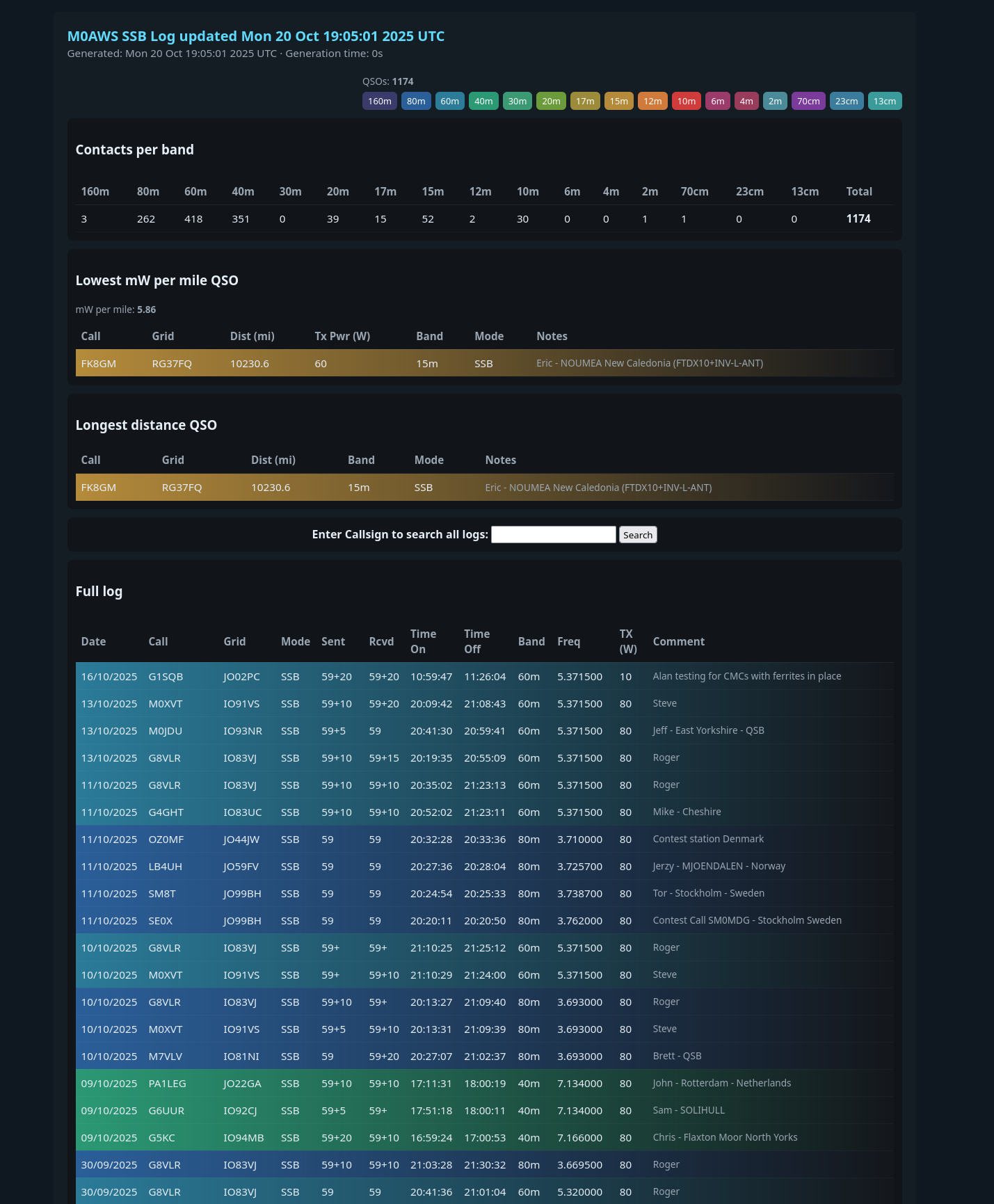
The 585 lines of code produce a very nice, modern looking web page and can be used to convert any ADIF file into HTML. The code is extremely quick, taking less than a second to process almost 2500 log entries, a huge improvement over the old version of adi2html.

New look M0AWS Log web page

All of my logs are available here on my blog under the Logs menu above, feel free to have a look at them.

I now need to rewrite the log search functionality so that it uses the same format of presentation for the results.

More soon …