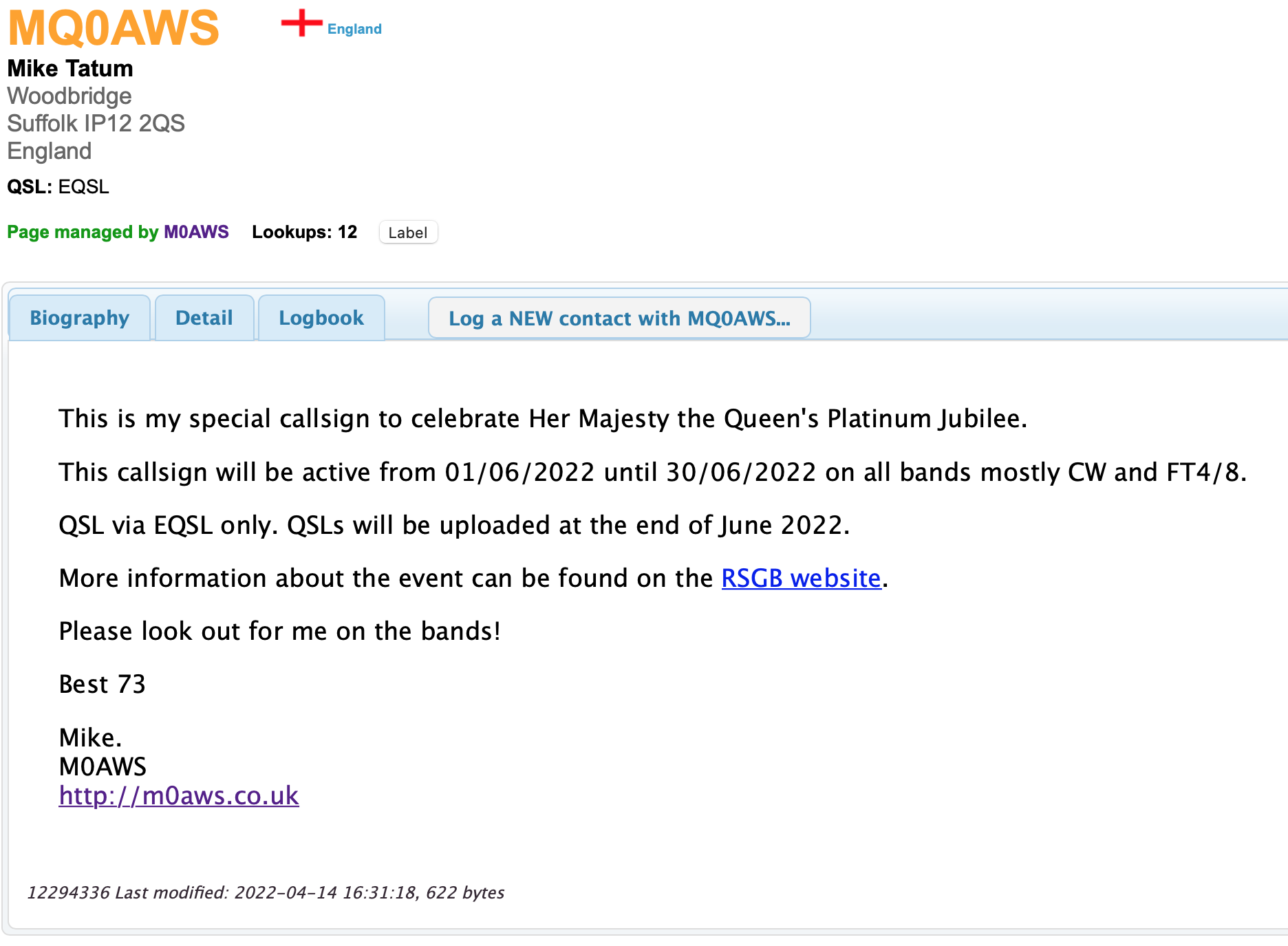
During the month of June 2022 U.K. radio HAMs will be able to use the “Q” regional secondary locator in their callsigns to celebrate Her Majesty the Queen’s Platinum Jubilee.
I now have my notice of variation (NOV) for my HAM Radio licence that will allow me to use the callsign of MQ0AWS throughout the month of June 2022.
I’ll be active on all HF bands using CW and FT4/8 mostly. I may do some SSB on 40/60m depending on how it goes.
I’m hoping many stations world wide will want to contact the GQ/MQ/2Q stations throughout the celebration period and that you’ll all be able to collect the 70 necessary callsigns and contacts to win an RSGB certificate.
I will be logging all contacts on EQSL.CC at the end of June 2022.
More information is available on the RSGB website.
I look forward to using the MQ callsign and hope to have many pileups on the bands!
To recap, the NVIS antenna is a 30m long end-fed wire that is between 3 and 4m above the ground over it’s entire length. This is the longest wire I could get into my tiny U.K. garden and so I wanted to see what was really possible with such a low short wire on the low bands. My goal was to get good Inter-G signals so that I could chat with other U.K. and close European stations during the summer months. The tuning is done automatically by the CG3000 remote ATU I picked up very cheaply on Ebay.
Having very anti-antenna neighbours I have to tread carefully not to upset them as I have already rattled some cages having the 20m EFHW Vertical on an extending fibre glass pole at the end of the garden overlooking the farmers field.
The CG3000 remote ATU matches the 30m wire nicely on the 160m band with an SWR of less than 1.2:1 across the entire band with multiple retunes. It’s certainly very convenient to have such a setup.
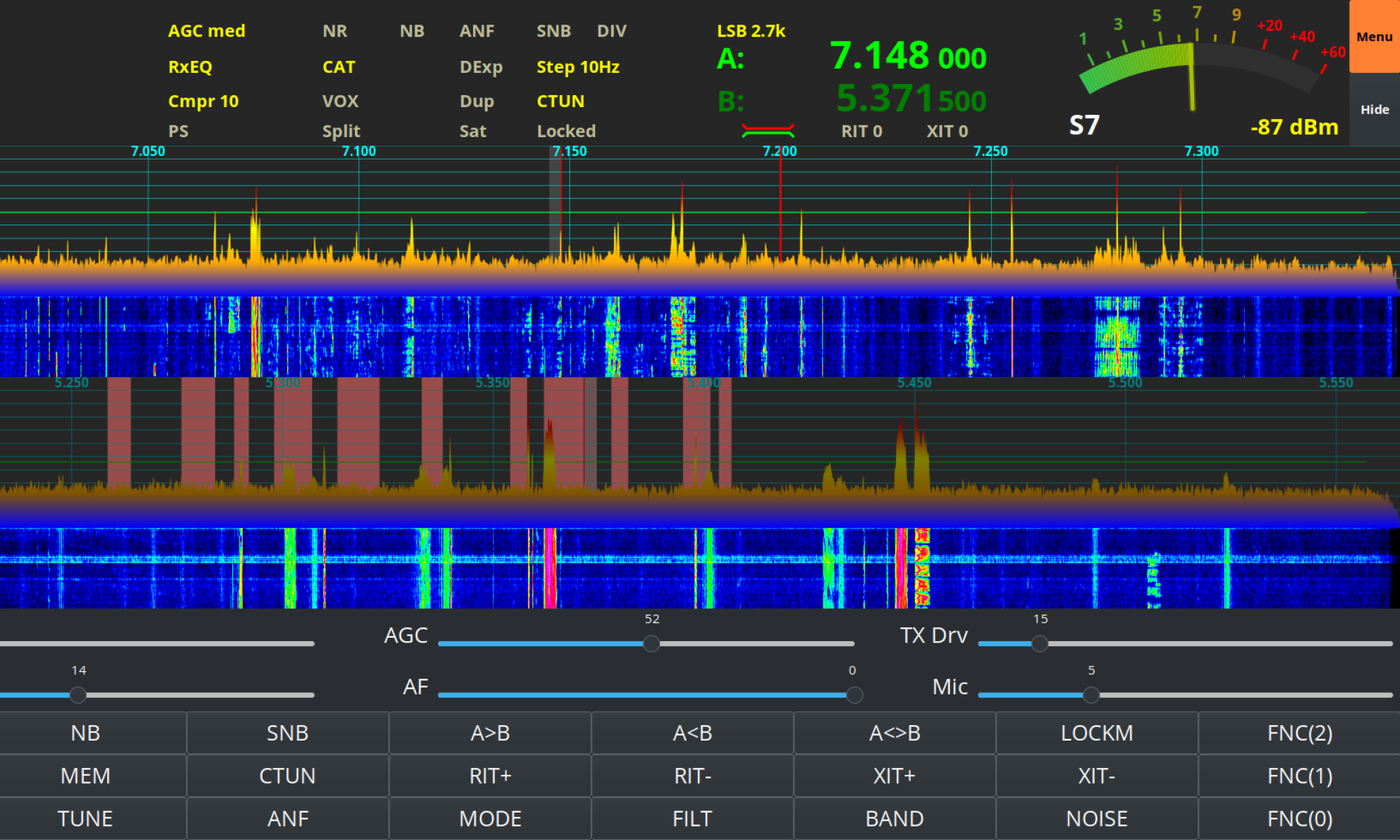
Setting the power output on the radio to 25w which is the maximum I use for FT4/FT8 on the Yaesu FTDX10 I started WSJT-X and waited to see what I could hear. With the background noise swinging between S7-9 most of the time I was surprised at how many stations were being decoded. Some of the stations were barely visible on the waterfall but, I got consistent reliable decodes.
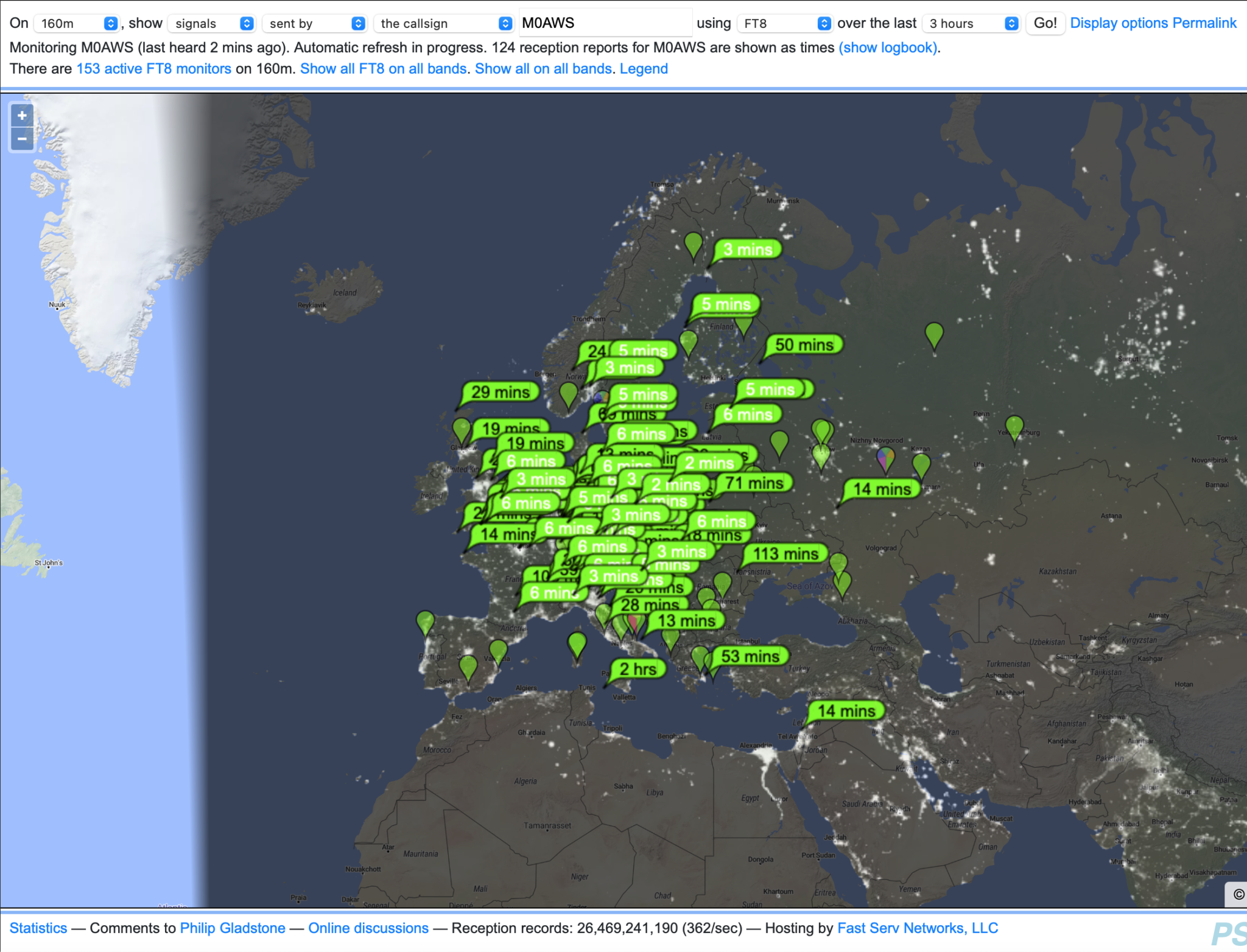
Stations heard during a 1 hour period on 160m NVIS Antenna Experiment
As you can see on the map above I was hearing stations from all over Europe and well into Russia. There certainly isn’t the proliferation of stations on the 160m band that there are on the 40m band but, there were enough for me to get some good results.
It was nice to reliably copy some U.K. stations on 160m FT8 even though I didn’t hear a single SSB station on the band.
Map showing stations that heard M0AWS on 160m during the NVIS Antenna Experiment
Over a period of about 3.5 hours I was heard by a good number of European stations but, wasn’t able to work all that I heard as I was struggling to compete with the much more powerful stations. Limiting my transmit power to 25w to protect the PA on the radio does tend to limit my success at getting through to stations at times but, I am a firm believer in being able to hear better than I can shout, especially on the low bands.
Map showing all stations worked during the 160m NVIS Antenna Experiment
Over the test period I didn’t work a huge number of stations but, I did manage to work stations over a large area of Europe with the best distance being 1004 Miles into Finland, much further than I ever thought would be possible with such a simple setup.
I’m sure that when the band is in better shape with lower noise levels and better propagation the antenna will post probably perform better but, it’s certainly proved it can do the short hop NVIS comms that I was looking for.
I have designed a new NVIS antenna for the garden which manages to incorporate considerably more wire into the same space that is resonant on the 80m band. With the CG3000 remote ATU it should tune up well on 40m-160m and give much better results. This design does require a 10m fibre glass expending pole which I need to purchase before I can erect it in the garden. I’ll get all the information for the design onto the Antenna section of the website soon.
So to summarise, a 30m end-fed wire at between 3 and 4m above the ground will give good NVIS results on 40m-160m with a very low visual impact. For those like me that have a small garden, a simple antenna like this is much better than no antenna at all.
More soon …
We use cookies to ensure that we give you the best experience on our website. If you continue to use this site we will assume that you are happy with it.