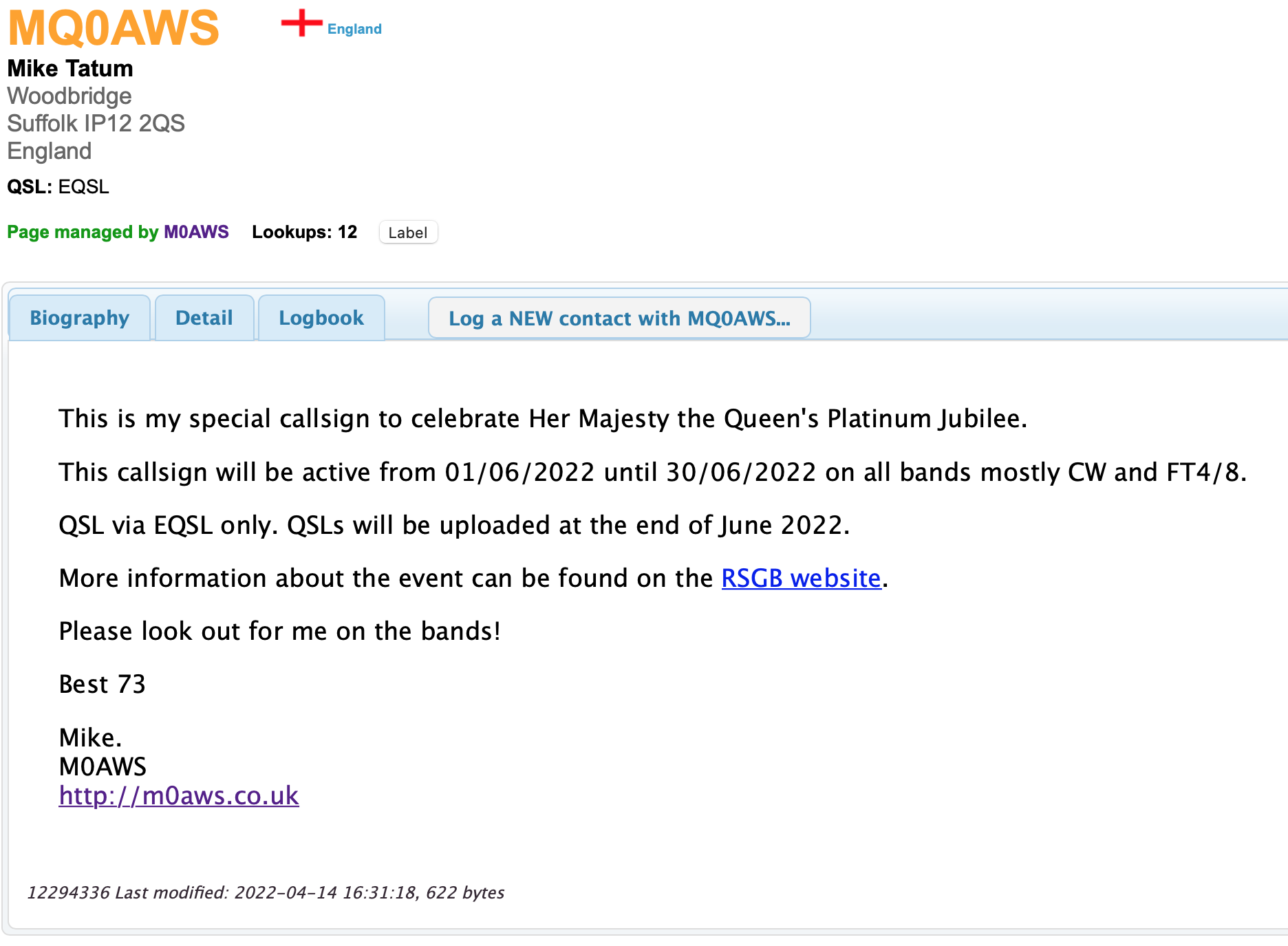
To celebrate Her Majesty the Queen Platinum Jubilee, marking 70 years of service to the people of the United Kingdom, the Realms and the Commonwealth, U.K. Radio Amateur (HAM) operators can apply for a Notice of Variation (NOV) to use the Q Regional Secondary Locator.
The RSGB will also be operating a bunch of GB70 special event stations, full details on the GB70 website.
I have my NOV and will be on air using MQ0AWS for the whole of June 2022.
This callsign will operate for one month only and so will be a rare one for you to get in your log.
I will be operating on all HF bands 160-10m CW & FT4/8 and maybe some SSB depending on conditions.
All MQ0AWS logs will be uploaded to my website almost realtime and will be uploaded to EQSL at the end of June 2022.
I spent some time this morning in the garden with the Icom IC-705/AH-705 combo connected to my End Fed Half Wave (EFHW) vertical for the 30m band. This is a great antenna that works superbly on the 30m band. Being a resonant half wave fed via a 49:1 Unun it doesn’t require any ATU inline normally and so it’s quick and easy to use with any radio.
Today I decided to disconnect and remove the 49:1 Unun and hook up the Icom AH-705 instead. I thought it would be an interesting exercise to see how well it handled the EFHW vertical on both 30m and the other bands.
Icom AH-705 connected to the 30m Band EFHW Vertical Antenna
I purchased a couple of 5m leads for the AH-705 so that I could setup the radio on the picnic table in the garden and be a comfortable distance from the antenna. They worked great and allow me to use the radio in the spring/summer sun with ease.
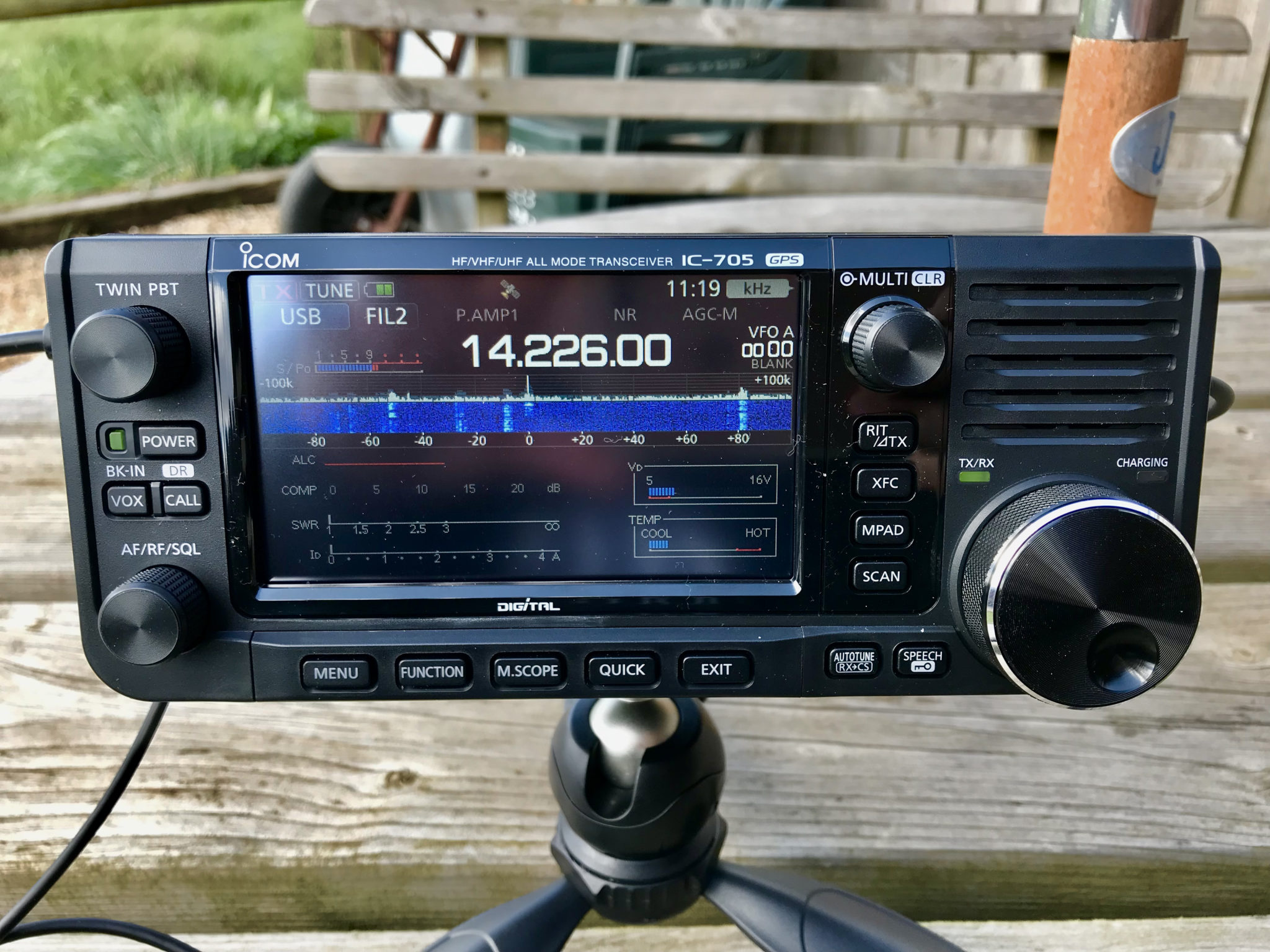
Icom IC-705 setup on the picnic table in the garden
The little AH-705 remote auto ATU really does work well with the IC-705. Each time you change bands all you have to do is give a quick press of the PTT on the mic and it automagically goes into tune mode and matches the antenna to the 50 Ohm radio in seconds.
I was was really pleased to see that the AH-705 ATU matched the EFHW Vertical for 30m on the 80m, 60m, 40m, 30m and 20m bands with a perfect 1:1 SWR. With the antenna consisting of 14.81m of wire this makes it somewhat short of a 1/4 wave on the 80m band and I’m not too sure how well it will work. On the 40m band it is a 3/8 wave antenna so should work well. It’s a 1/4 wave on the 60m band and of course a half wave on 30m band as per it’s original design. On the 20m band it is just under 3/4 wavelength long so hopefully should work reasonably well. Of course it won’t be as good as my 20m band EFHW Vertical that has a much lower angle of radiation but, will make an interesting comparison.
The antenna also tunes up nicely on all the other higher bands including the WARC bands. On 17m it is getting close to a full wave length and on 15m it is just over a full wavelength and so should work fairly well on these two bands albeit with a higher than optimal angle of maximum radiation.
On the 12m band it is 1.25 wavelengths long and of course on the 10m band it is almost 1.5 wavelengths long. I’m not sure how well it is going to work on these two higher bands but, for a 14.81m long piece of wire it certainly gives me a good chance on a wide spectrum of frequencies.
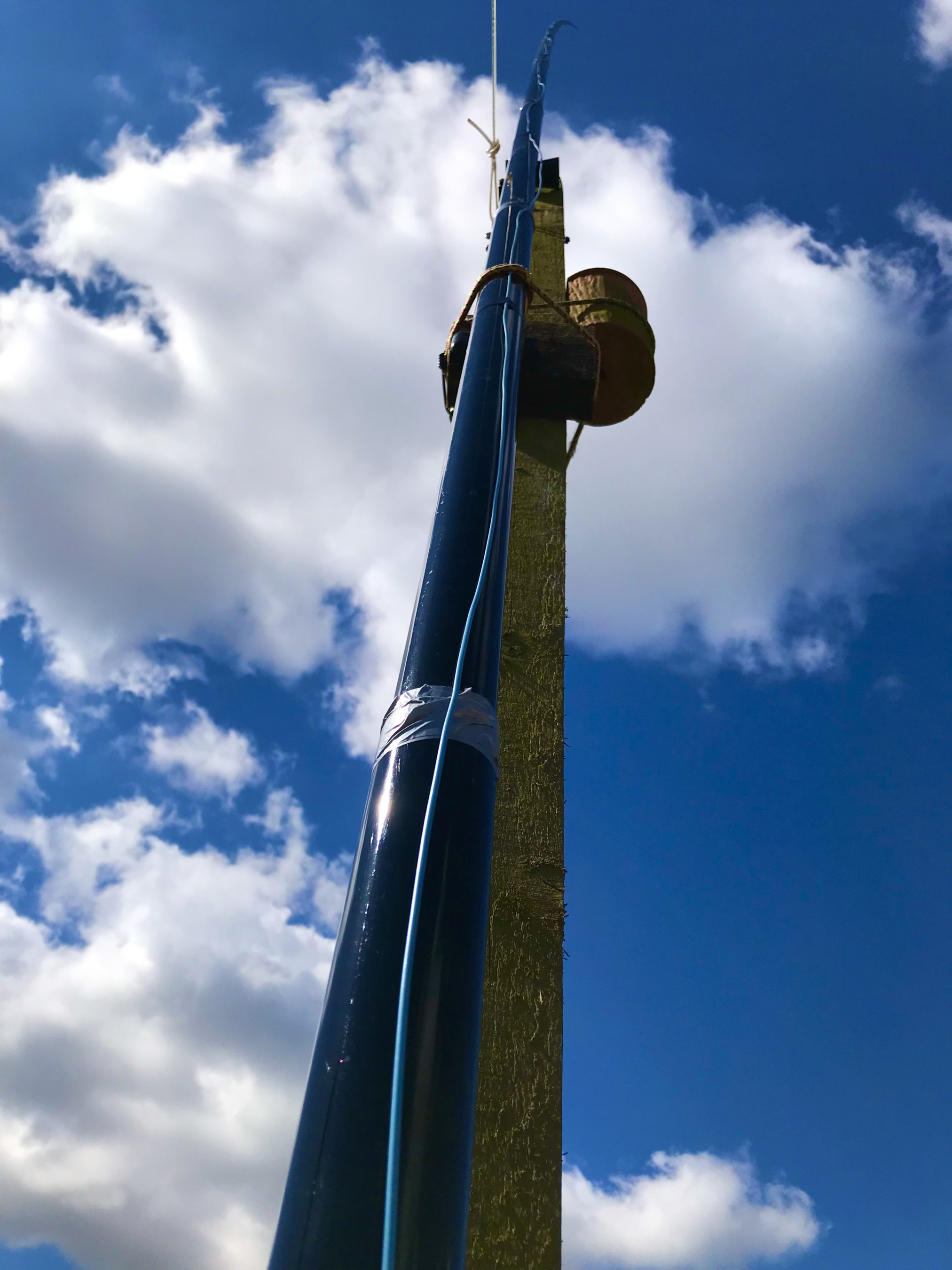
30m Band EFHW Vertical Antenna in the breeze
The bands weren’t in particularly good shape this morning but, I found some SSB signals on the 20m band and so decided to see if I could make some contacts.
First contact was with S51DX in Slovenia. He was using 1kw into a 5 element beam pointed pretty much directly at me. The little IC-705 S meter took a pounding with him peaking +30db over S9 most of the time. I was really pleased to get a 5/9 report from him using just 5w from the IC-705 on the standard 7v battery. Of course his station was doing all the work but, it’s good to take advantage of these big stations when running QRP power levels.
Next I had a QSO with John, EA7JUR in Almeria Spain. But this time the battery on the IC-705 was pretty much exhausted and so I hooked it up to the 12v supply to get it charging whilst I was on air. This of course gave me the ability to increase my O/P power by 100% to a massive 10w!
I wasn’t so strong at John’s end, only getting 5/5 report at best whilst he was 5/5-5/9 with me with some QSB. John was using a mini beam antenna again pointed towards me so once again all the work was being done at his end. We had a good chat for a number of minutes until it was time for lunch.
Listening on the 40m band I did hear a very interesting station, KN6IPA/Aeronautical-Mobile. Justin, KN6IPA is part of the crew on a USAF KC135 air-to-air refuelling tanker that flies out of RAF Lakenheath in the U.K. He was transmitting from the aircraft whilst in flight over Germany. His signal was between 5/9 and 5/9+20dB on my vertical antenna and had a massive pileup of people calling him from all over Europe.
I did try calling him with my punchy 10w of power but, couldn’t compete with the huge pileup of very loud, powerful stations all incessantly calling. It was really interesting to just sit back and listen to Justin’s information. He was using 300w into a wire antenna that runs from the fuselage to the vertical stabiliser. Of course being so high up he had a massive advantage and could be heard for hundreds of miles with ease, hence every one and their dog was calling him.
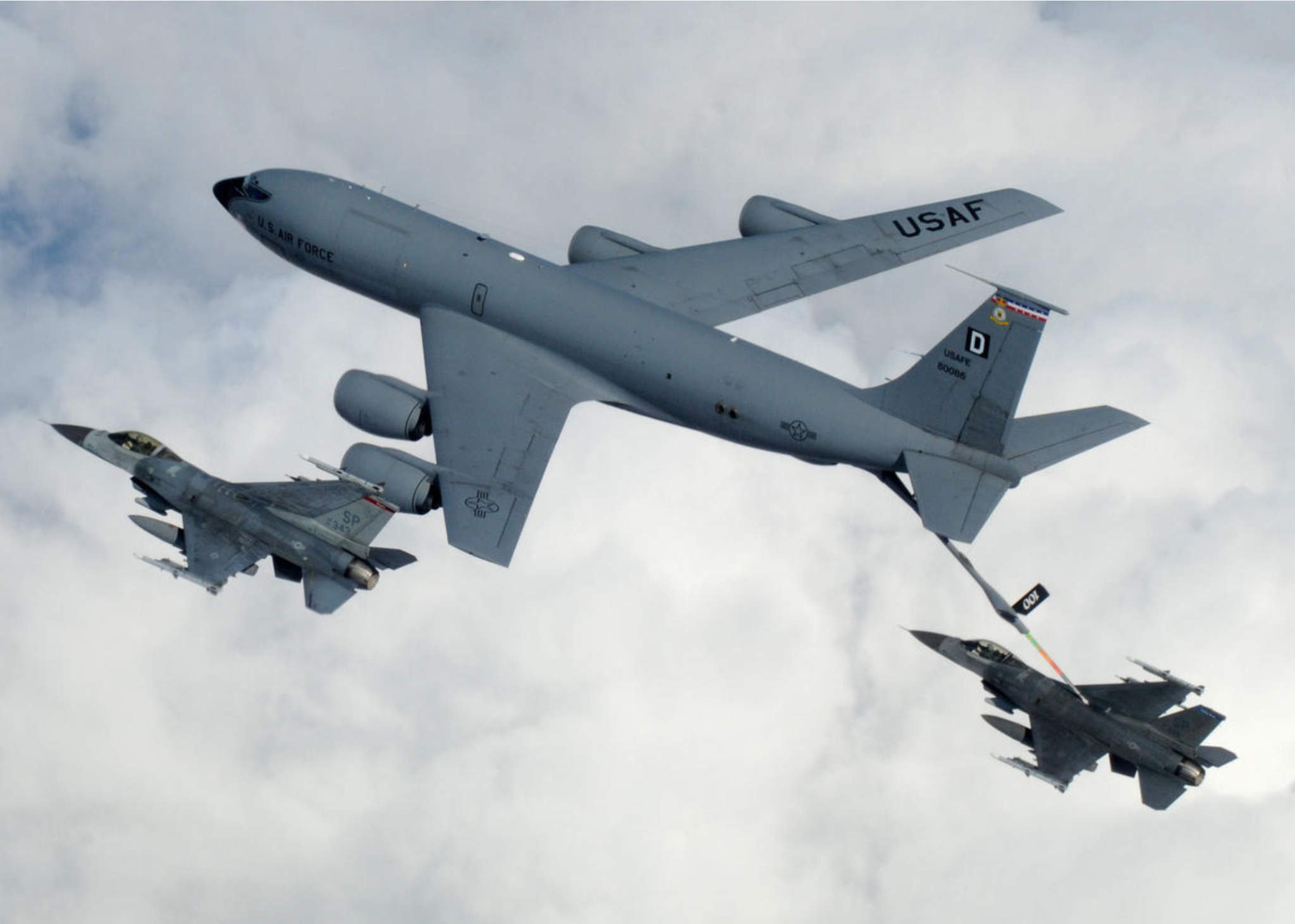
Photo of the KC135 tanker that KN6IPA was transmitting from courtesy of his QRZ.COM page
If you look closely at the photo above of the KC135 that Justin is a crew member on you can just make out the wire antenna on the vertical stabiliser.
I have to admit that I would love to spend a few hours on the radio aboard the KC135 whilst it was flying around, just imagine the DX you could work!
During the month of June 2022 U.K. radio HAMs will be able to use the “Q” regional secondary locator in their callsigns to celebrate Her Majesty the Queen’s Platinum Jubilee.
I now have my notice of variation (NOV) for my HAM Radio licence that will allow me to use the callsign of MQ0AWS throughout the month of June 2022.
I’ll be active on all HF bands using CW and FT4/8 mostly. I may do some SSB on 40/60m depending on how it goes.
I’m hoping many stations world wide will want to contact the GQ/MQ/2Q stations throughout the celebration period and that you’ll all be able to collect the 70 necessary callsigns and contacts to win an RSGB certificate.
I will be logging all contacts on EQSL.CC at the end of June 2022.
More information is available on the RSGB website.
I look forward to using the MQ callsign and hope to have many pileups on the bands!
I recently acquired a CG3000 Automatic Remote antenna tuner from Ebay that was advertised as being new, still in the box unused. I’m always very wary about purchasing stuff from Ebay as the site is full of scams and cheap Chinese rubbish these days.
I decided it would be handy to have an auto remote ATU to enable me to band hop quickly and easily without having to go outside and tinker so, I thought I’d put in a silly offer and see what happens.
Putting in an incredibly low offer I didn’t expect to hear anything however, the following day the offer was accepted! At this point I thought well it’s either a scam or someone just wants rid of it for one reason or another.
4 days after paying for the unit it arrived and sure enough, it was new still in it’s box and original wrapping, bargain!
Initially I used the CG3000 to make an NVIS antenna for inter-G contacts on the low bands. It worked extremely well and I’ve kept the 30m long end fed wire in place so that I can chat with other UK stations throughout the summer months.
Wanting to experiment further with the CG3000 I thought I’d look into getting onto the WARC bands as summer is coming and the higher bands normally come alive during the warmer months. Having the CG3000 remote tuner in the garden already I decided to see if I could make a vertical that would work on the higher frequencies. I started to look into what length of wire I should use with the tuner to get the best results across the bands and finally decided to go with 8.3m.
8.3m might seem a strange length to go with but, there is method to my madness!
8.3m is a half wave on the 17m band, this should be great for DXing as it will have a very low angle of radiation, around 5 degrees.
On the 15m band it will be roughly a meter longer than a half wave but, modelling shows it will still be good for working the DX.
On the 12m band it will be just under a 3/4 wave length, it will have a higher angle of radiation than on 17m and 15m but, it should still work well.
On the 30m band it will be just over a 1/4 wave length, this will also be good for DXing and will give me another band to play with.
Finally, on the 40m band it will be a little shorter than a quarter wave but, should still work fairly well and give me the ability to switch between the 5 bands in seconds.
I’m not worried about using it on the 20m or 10m band as these two are covered by my 20m EFHW vertical antenna that has already proven to be a superb DX antenna.
In the back of the shed I had a new 8.5m long telescopic fibreglass pole that would be ideal for getting the wire into the air. The CG3000 needs a relatively good ground connection and radials to tune against, fortunately I’d already sorted the ground out when I set the tuner up for the 30m long end fed NVIS antenna.
CG3000 Automatic Remote ATU connected to ground and antenna wire
Powering it up it tuned on all the bands I wanted and as a bonus it tuned the 80m band too. I doubt it will be particularly good on 80m as 8.3m of wire is rather short for such a low frequency but, could be OK for local ground-wave chatter.
So it was time to get on the air and see how it performed.
First up was 17m, the band was active which was good to hear and I set about working a few stations.
Stations worked on the 17m band using the CG3000 ATU and vertical antenna
Working into Japan was a breeze on 17m, I couldn’t believe it when I got through to JA4FKX first call. I also got into Thailand HS6OKJ first call too. I worked a few European and Russian stations and then started hunting for stations further afield. It wasn’t long before I’d worked PY7ZC and PY2IQ in Brazil, YV4GLF in Venezuala and a bunch of East Coast USA stations. As the sun headed west I worked VE7SA and VA7QI on the West Coast of Canada.
Tuning up on the 15m band I found the it was pretty dead however, I did manage to work VE1JBC which proved the antenna worked on 21Mhz but, needed more testing when the conditions are better.
Tuning up onto 12m was the same story, completely dead apart from one station calling CQ, LU8EX in Argentina! I gave a call back and got an immediate reply. We exchanged signal reports and then he was gone. More testing is also needed on this band but, getting into Argentina more than proves it’s a DX worthy antenna for the 12m band.
Tuning onto the 30m band I found a hive of activity and so set about working stations to see how the CG3000 and antenna combo worked on the lower frequencies. To my surprise it was extremely effective.
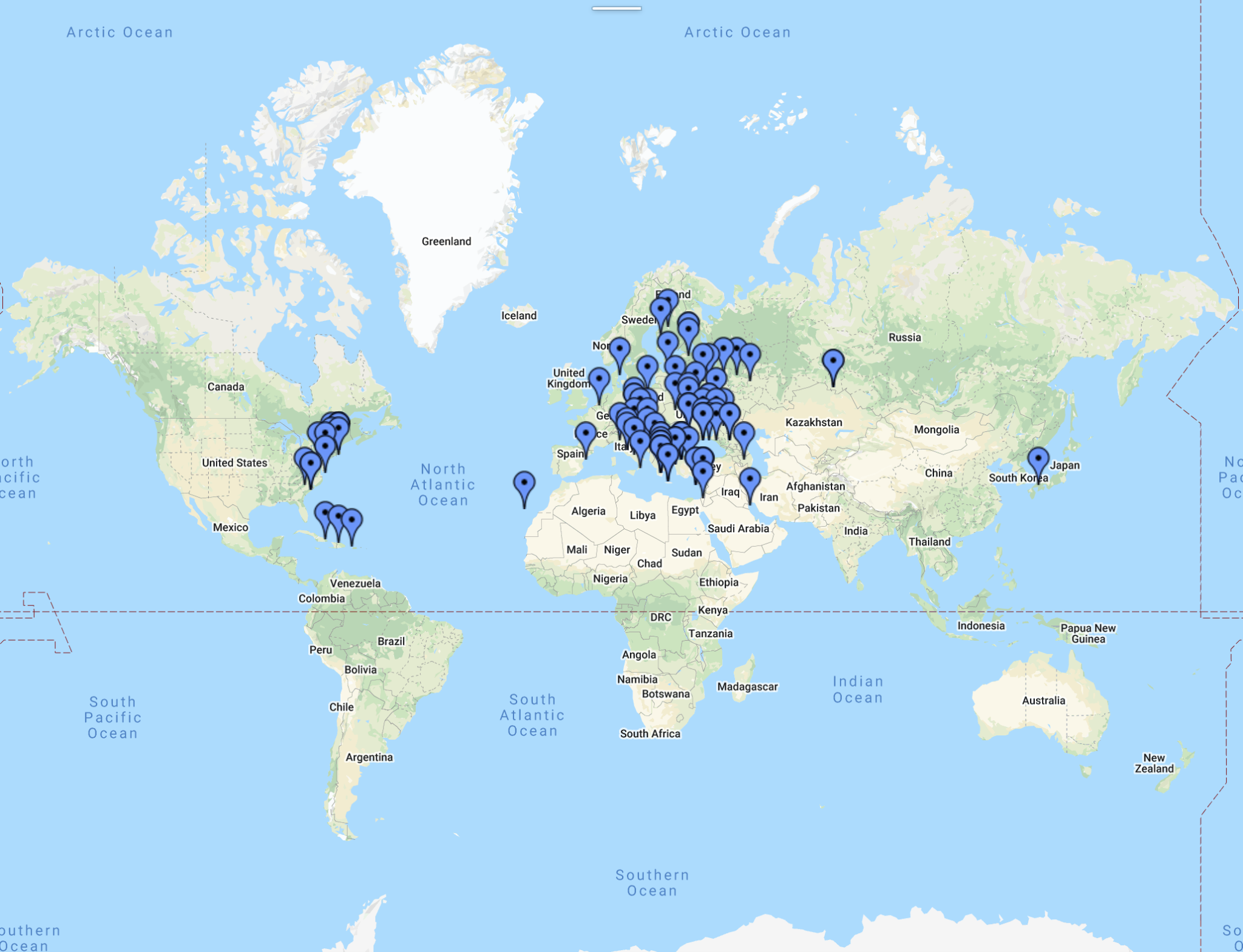
Stations worked on the 30m band using the CG3000 ATU and vertical antenna
As you can see on the map above, the slightly long 1/4 wave length antenna worked very well on the 30m band and I’ve been able to get contacts in Japan, Russia, most of Europe and into the East Coast USA and Caribbean. 8.3m of vertical wire makes an extremely good 30m band antenna!
I didn’t have a lot of time to check out the 40m band however, I did manage to work a few stations before I had to disappear. The CG3000 ATU tuned the 8.3m of wire up beautifully and I was surprised how many stations I could hear during the daylight hours.
Stations worked on the 40m band using the CG3000 ATU and vertical antenna
I worked a few stations on 40m before closing down and heading off to do other, more important things. Considering it was still daylight I was impressed to get UI4P at just under 2000 miles. I clearly need to spend more time on the 40m band late into the night to see how well the antenna performs but, it looks promising!
So overall, the CG3000 remote auto tuner and 8.3m of wire give me exactly what I wanted, 17, 15m and 12m with the added bonus of 30m and 40m. DXing over the summer months will be a lot of fun for sure!
UPDATE: It works incredibly well on the 60m band too! I’ve just had to manage my first ever FT8 pileup on 60m including contacts into Canada, USA and Puerto Rico.
More soon …
Multi-band vertical tuned with CG3000 Remote Auto Tuner
We use cookies to ensure that we give you the best experience on our website. If you continue to use this site we will assume that you are happy with it.