HMQ Platinum Jubilee NoV

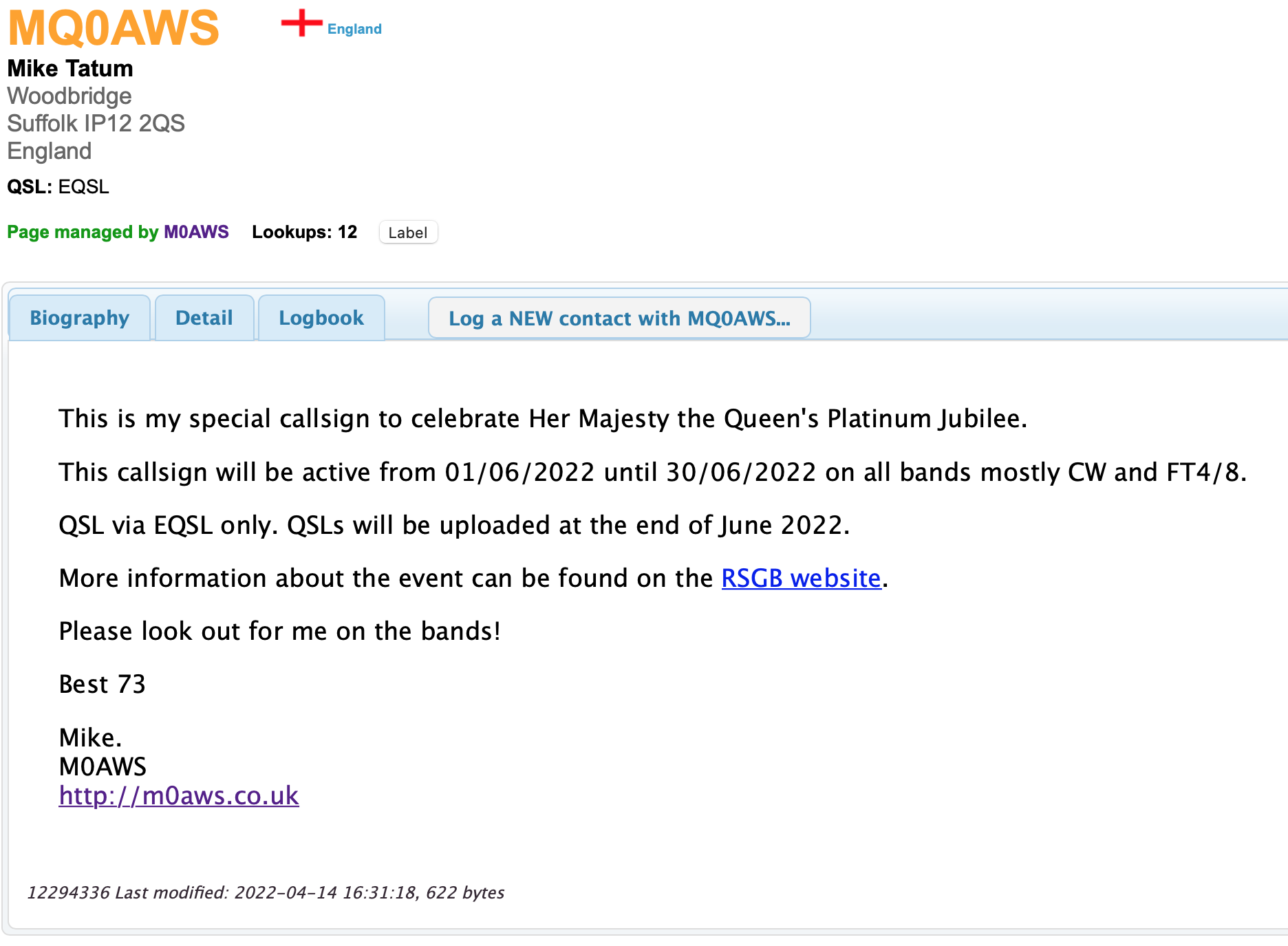
MQ0AWS QRZ.COM entry

During the month of June 2022 U.K. radio HAMs will be able to use the “Q” regional secondary locator in their callsigns to celebrate Her Majesty the Queen’s Platinum Jubilee.

I now have my notice of variation (NOV) for my HAM Radio licence that will allow me to use the callsign of MQ0AWS throughout the month of June 2022.

I’ll be active on all HF bands using CW and FT4/8 mostly. I may do some SSB on 40/60m depending on how it goes.

I’m hoping many stations world wide will want to contact the GQ/MQ/2Q stations throughout the celebration period and that you’ll all be able to collect the 70 necessary callsigns and contacts to win an RSGB certificate.

I will be logging all contacts on EQSL.CC at the end of June 2022.

More information is available on the RSGB website.

I look forward to using the MQ callsign and hope to have many pileups on the bands!

More soon …

Band hopping with the CG3000

I recently acquired a CG3000 Automatic Remote antenna tuner from Ebay that was advertised as being new, still in the box unused. I’m always very wary about purchasing stuff from Ebay as the site is full of scams and cheap Chinese rubbish these days.

I decided it would be handy to have an auto remote ATU to enable me to band hop quickly and easily without having to go outside and tinker so, I thought I’d put in a silly offer and see what happens.

Putting in an incredibly low offer I didn’t expect to hear anything however, the following day the offer was accepted! At this point I thought well it’s either a scam or someone just wants rid of it for one reason or another.

4 days after paying for the unit it arrived and sure enough, it was new still in it’s box and original wrapping, bargain!

Initially I used the CG3000 to make an NVIS antenna for inter-G contacts on the low bands. It worked extremely well and I’ve kept the 30m long end fed wire in place so that I can chat with other UK stations throughout the summer months.

Wanting to experiment further with the CG3000 I thought I’d look into getting onto the WARC bands as summer is coming and the higher bands normally come alive during the warmer months. Having the CG3000 remote tuner in the garden already I decided to see if I could make a vertical that would work on the higher frequencies. I started to look into what length of wire I should use with the tuner to get the best results across the bands and finally decided to go with 8.3m.

8.3m might seem a strange length to go with but, there is method to my madness!

8.3m is a half wave on the 17m band, this should be great for DXing as it will have a very low angle of radiation, around 5 degrees.

On the 15m band it will be roughly a meter longer than a half wave but, modelling shows it will still be good for working the DX.

On the 12m band it will be just under a 3/4 wave length, it will have a higher angle of radiation than on 17m and 15m but, it should still work well.

On the 30m band it will be just over a 1/4 wave length, this will also be good for DXing and will give me another band to play with.

Finally, on the 40m band it will be a little shorter than a quarter wave but, should still work fairly well and give me the ability to switch between the 5 bands in seconds.

I’m not worried about using it on the 20m or 10m band as these two are covered by my 20m EFHW vertical antenna that has already proven to be a superb DX antenna.

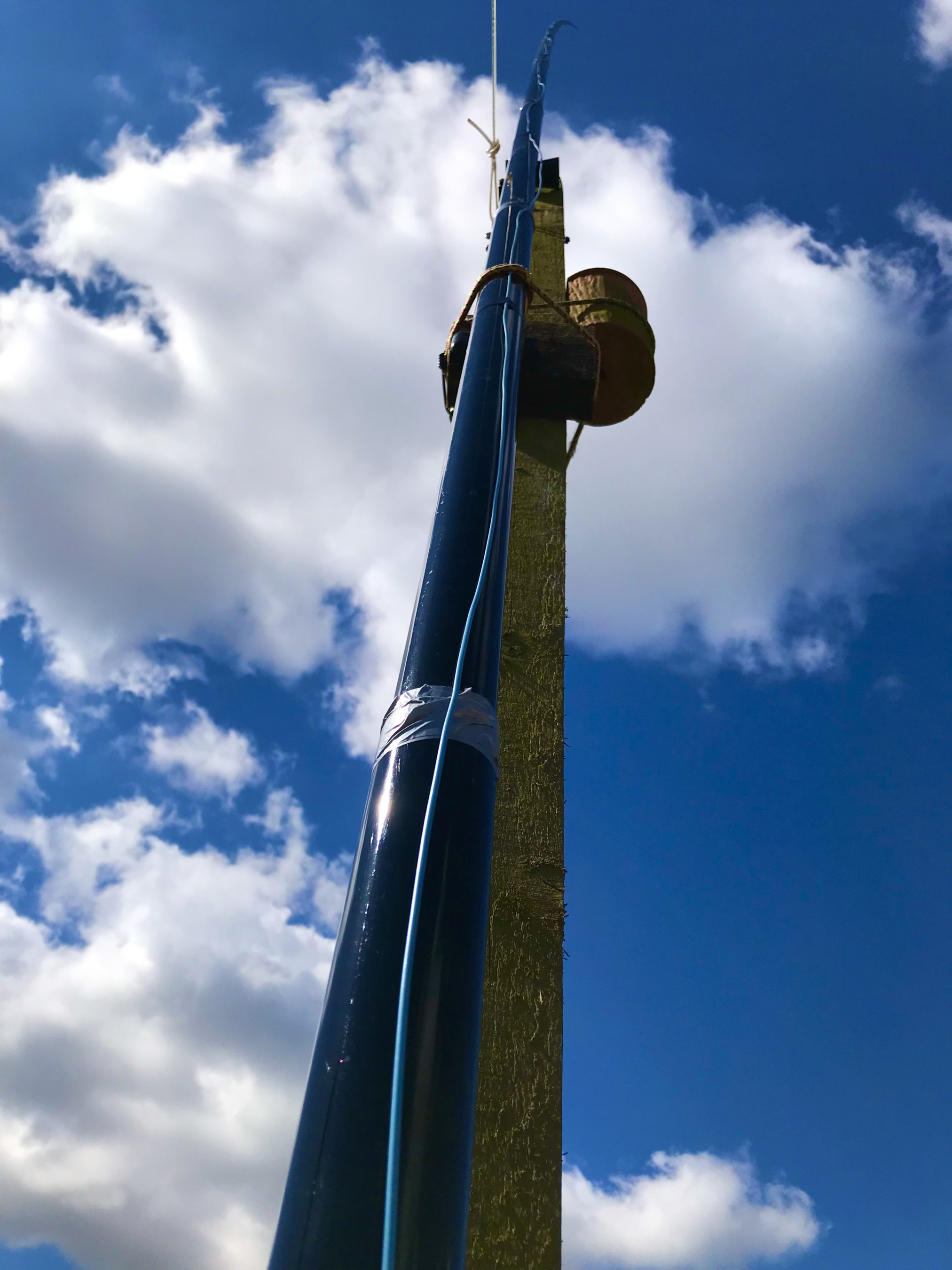
In the back of the shed I had a new 8.5m long telescopic fibreglass pole that would be ideal for getting the wire into the air. The CG3000 needs a relatively good ground connection and radials to tune against, fortunately I’d already sorted the ground out when I set the tuner up for the 30m long end fed NVIS antenna.

CG3000 Automatic Remote ATU connected to ground and antenna wire

Powering it up it tuned on all the bands I wanted and as a bonus it tuned the 80m band too. I doubt it will be particularly good on 80m as 8.3m of wire is rather short for such a low frequency but, could be OK for local ground-wave chatter.

So it was time to get on the air and see how it performed.

First up was 17m, the band was active which was good to hear and I set about working a few stations.

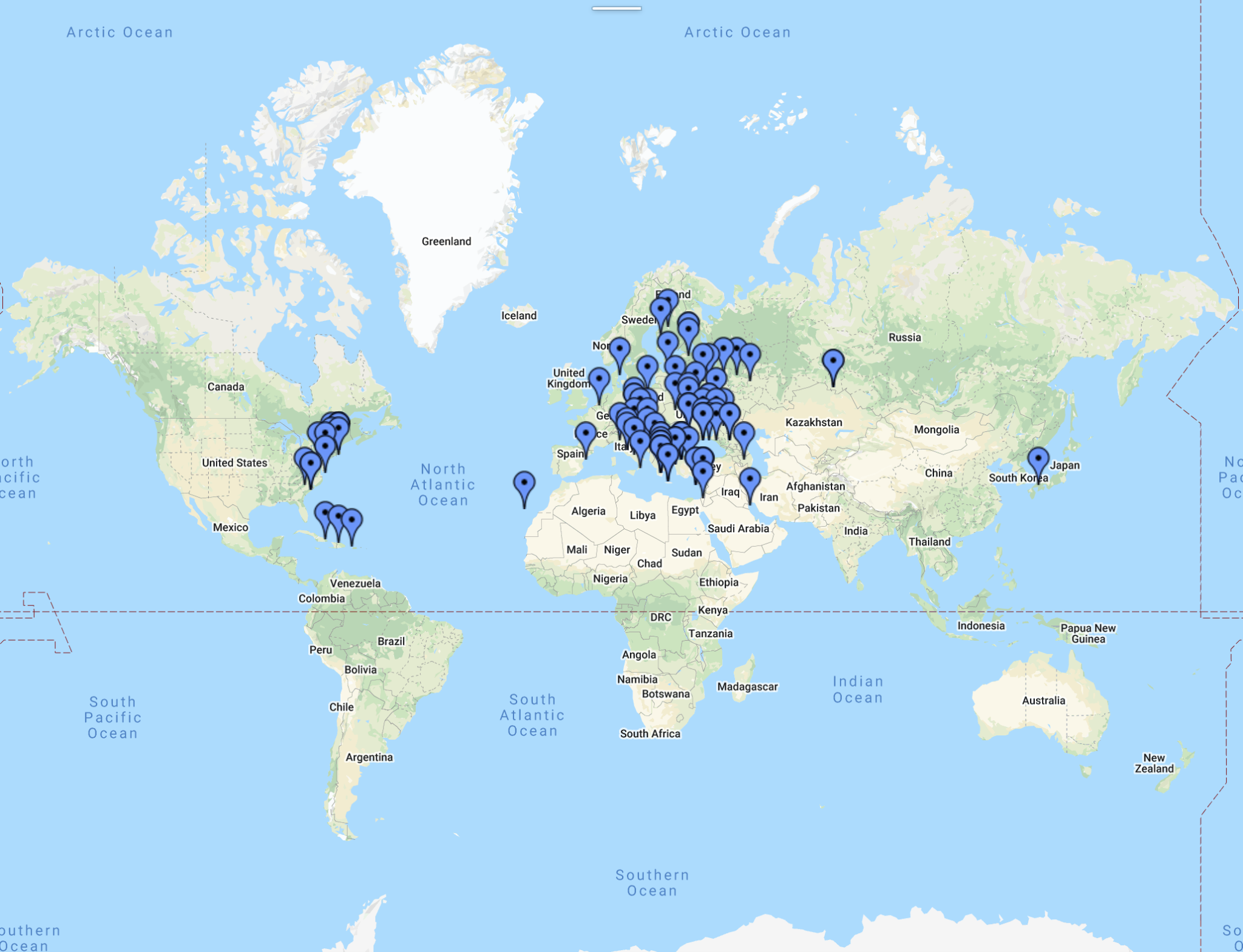
Stations worked on the 17m band using the CG3000 ATU and vertical antenna

Working into Japan was a breeze on 17m, I couldn’t believe it when I got through to JA4FKX first call. I also got into Thailand HS6OKJ first call too. I worked a few European and Russian stations and then started hunting for stations further afield. It wasn’t long before I’d worked PY7ZC and PY2IQ in Brazil, YV4GLF in Venezuala and a bunch of East Coast USA stations. As the sun headed west I worked VE7SA and VA7QI on the West Coast of Canada.

Tuning up on the 15m band I found the it was pretty dead however, I did manage to work VE1JBC which proved the antenna worked on 21Mhz but, needed more testing when the conditions are better.

Tuning up onto 12m was the same story, completely dead apart from one station calling CQ, LU8EX in Argentina! I gave a call back and got an immediate reply. We exchanged signal reports and then he was gone. More testing is also needed on this band but, getting into Argentina more than proves it’s a DX worthy antenna for the 12m band.

Tuning onto the 30m band I found a hive of activity and so set about working stations to see how the CG3000 and antenna combo worked on the lower frequencies. To my surprise it was extremely effective.

Stations worked on the 30m band using the CG3000 ATU and vertical antenna

As you can see on the map above, the slightly long 1/4 wave length antenna worked very well on the 30m band and I’ve been able to get contacts in Japan, Russia, most of Europe and into the East Coast USA and Caribbean. 8.3m of vertical wire makes an extremely good 30m band antenna!

I didn’t have a lot of time to check out the 40m band however, I did manage to work a few stations before I had to disappear. The CG3000 ATU tuned the 8.3m of wire up beautifully and I was surprised how many stations I could hear during the daylight hours.

Stations worked on the 40m band using the CG3000 ATU and vertical antenna

I worked a few stations on 40m before closing down and heading off to do other, more important things. Considering it was still daylight I was impressed to get UI4P at just under 2000 miles. I clearly need to spend more time on the 40m band late into the night to see how well the antenna performs but, it looks promising!

So overall, the CG3000 remote auto tuner and 8.3m of wire give me exactly what I wanted, 17, 15m and 12m with the added bonus of 30m and 40m. DXing over the summer months will be a lot of fun for sure!

UPDATE: It works incredibly well on the 60m band too! I’ve just had to manage my first ever FT8 pileup on 60m including contacts into Canada, USA and Puerto Rico.

More soon …

Multi-band vertical tuned with CG3000 Remote Auto Tuner

40m Band NVIS Antenna Experiment

Since setting up the new station at my U.K. QTH I’ve not had any Inter-G contacts. This has mainly been due to the fact that the antennas I’ve currently got in place are all designed for chasing DX and so have far too low a radiation angle to be able to talk to other U.K. stations.

One of the things I do like about radio is the local chatter on the low bands. In the summer months working Inter-G on the low bands is most enjoyable so, I decided to put up a simple Near Vertical Incident Skywave (NVIS) antenna ready for the summer.

Unlike my French QTH, here in Suffolk we only have a tiny garden and so it’s a challenge to get any length of wire up that is anywhere near long enough for the low bands.

A quick measuring of the garden I worked out I could get 30m of wire approximately 3-4m off the ground at best. I’m very aware of my anti-antenna neighbours and so it needs to be as stealthy as possible.

I decided to use some 1.5mm wire that I had in the workshop and utilise the high washing line poles that are already in place to get the wire along the max length of the garden.

With the wire in place and connected to the CG3000 auto remote tuner that I got off of Ebay for a song, ground post and radials connected I found that the antenna tunes up fine on all 3 low bands, perfect!

Tuning up on the 40m band I had an SWR 1:1 anywhere on the band. I could hear a number of strong U.K. stations and a few Dutch and German stations too. Since I’m on the East Coast of the U.K. The Netherlands and Germany aren’t that far away as the crow flies.

Setting the radio onto 40w SSB (First time on SSB in a very long time!) I put out a call. First station to come back was G8VVY, Robin in Malmesbury Wiltshire. Signals weren’t particularly strong and I gave him a 4/4 report and got a 5/5 in return.

Next station was PA3GLK, Dave in The Netherlands. Again signal reports were 5/5 and 5/6 but, perfectly readable.

Next up was G0SXC, Kevin in Lancashire. Signal reports were 5/9 both ways this time, very strong and fully quietening, the high angle radiation was doing its thing!

Last call was ON3PAT, Pat in Belgium. Very strong signals both ways, 5/9++ at a distance of 153 miles. NVIS propagation is working very well. I turned the output down to just 25w and Pat still gave me a 5/9 report.

Later in the day I decided to run some FT8 QSOs on 40m to see how far I could get reliably with no more than 25w. I was hoping that I may just be able to get 1000 miles as an absolute maximum but, be able to work stations at 100 Miles or less with ease.

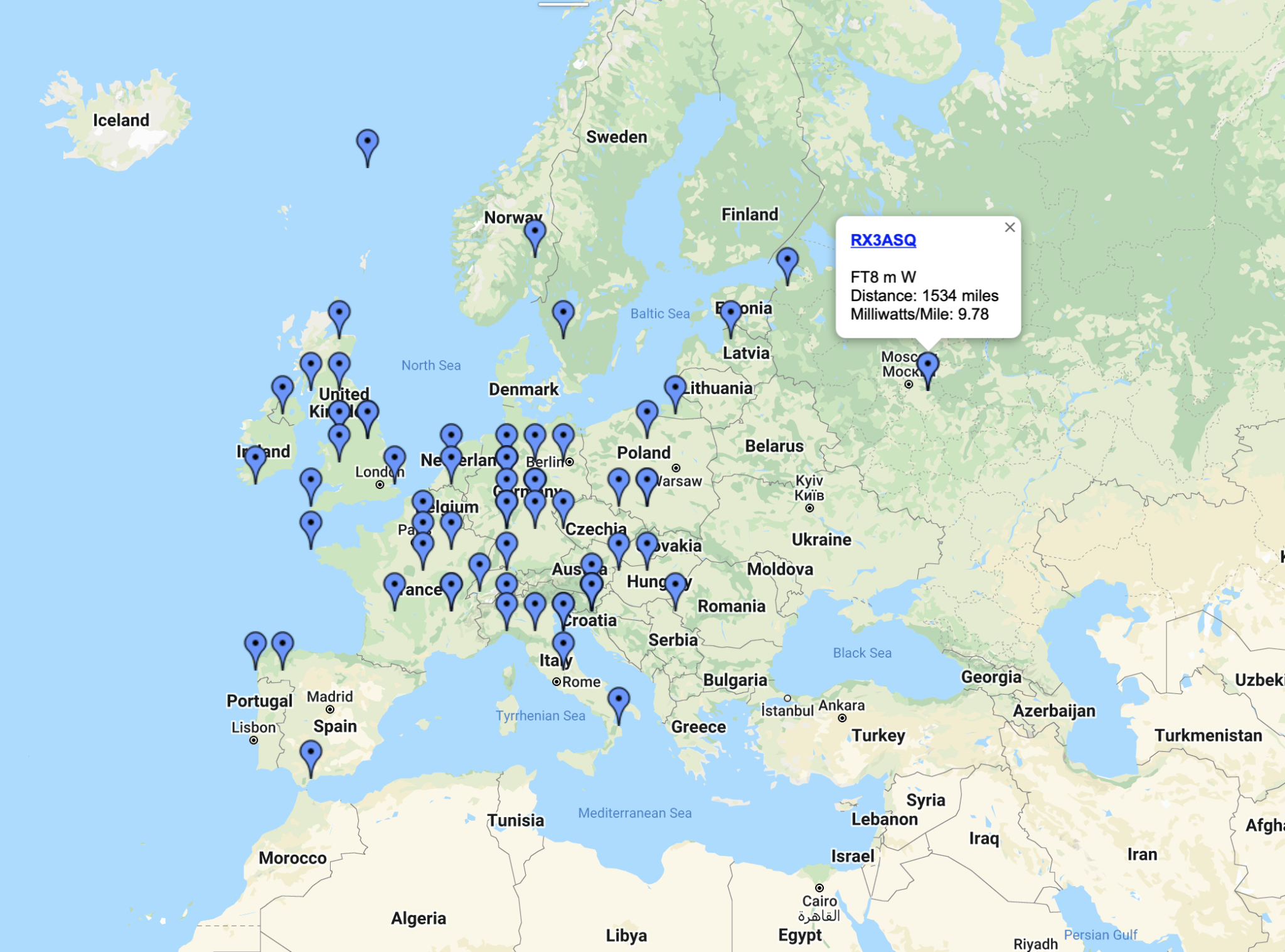
Map showing NVIS FT8 contacts on the 40m band

As you can see on the map above, 1534 miles was the best achieved, RX3ASQ just east of Moscow. The thing that pleased me most was the number of U.K. stations I could hear with the closest being just 43 miles away. Most European stations were easily worked even with reduced levels of power (10w) and so I’m hoping that this simple end fed NVIS antenna will become my goto antenna for local chatter on the 40m band.

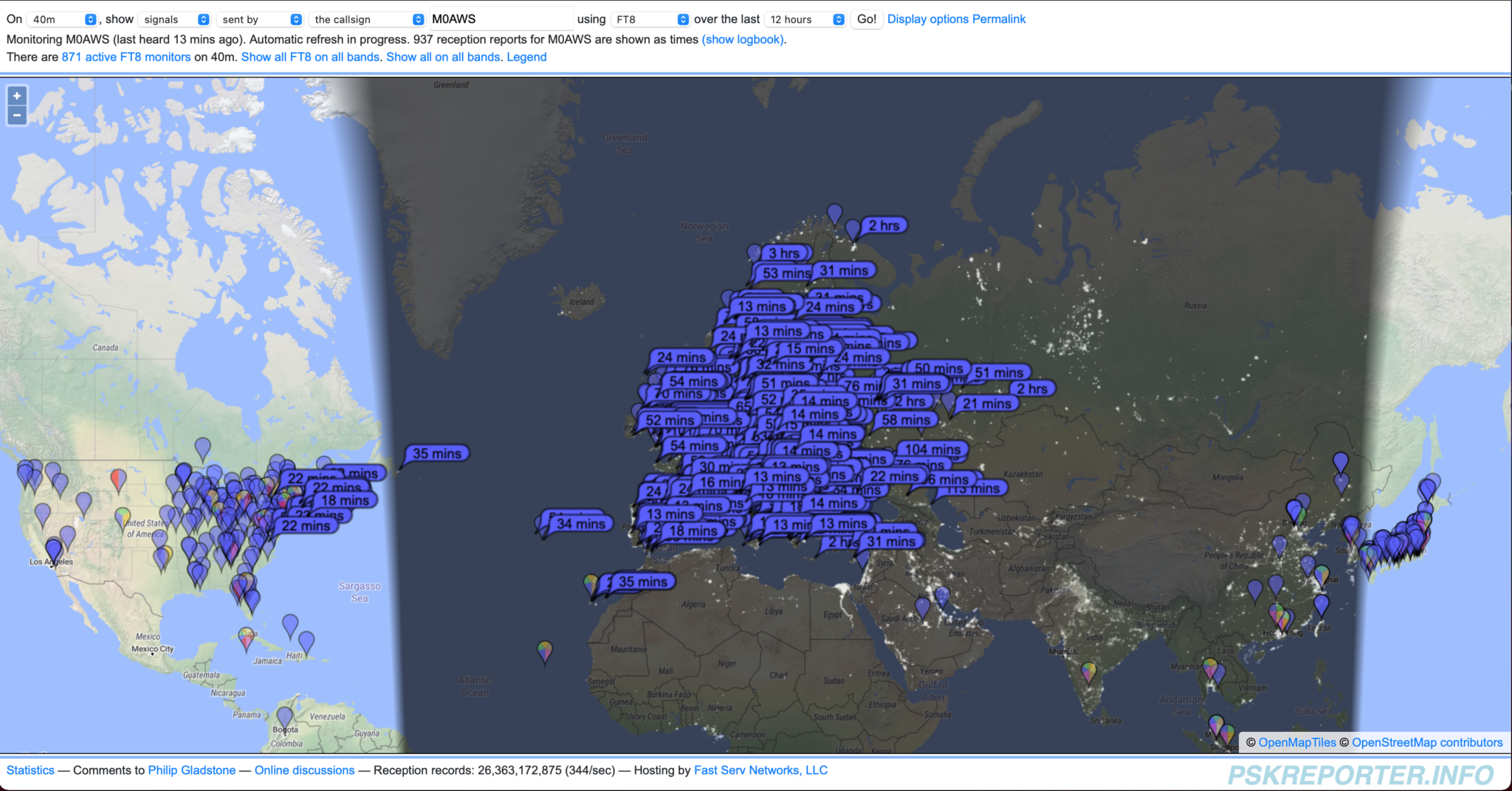
What was very interesting was what I could hear on the antenna, I didn’t expect to hear any DX stations at all however, I was surprised to see stations from Mongolia, Japan and the USA popping up in the WSJT-X window.

Obviously I couldn’t get back to them as my angle of radiation was far too high to get a signal out over those distances but, it just goes to show what can be a heard on a very low long wire.

Map showing stations heard on 40m using NVIS antenna

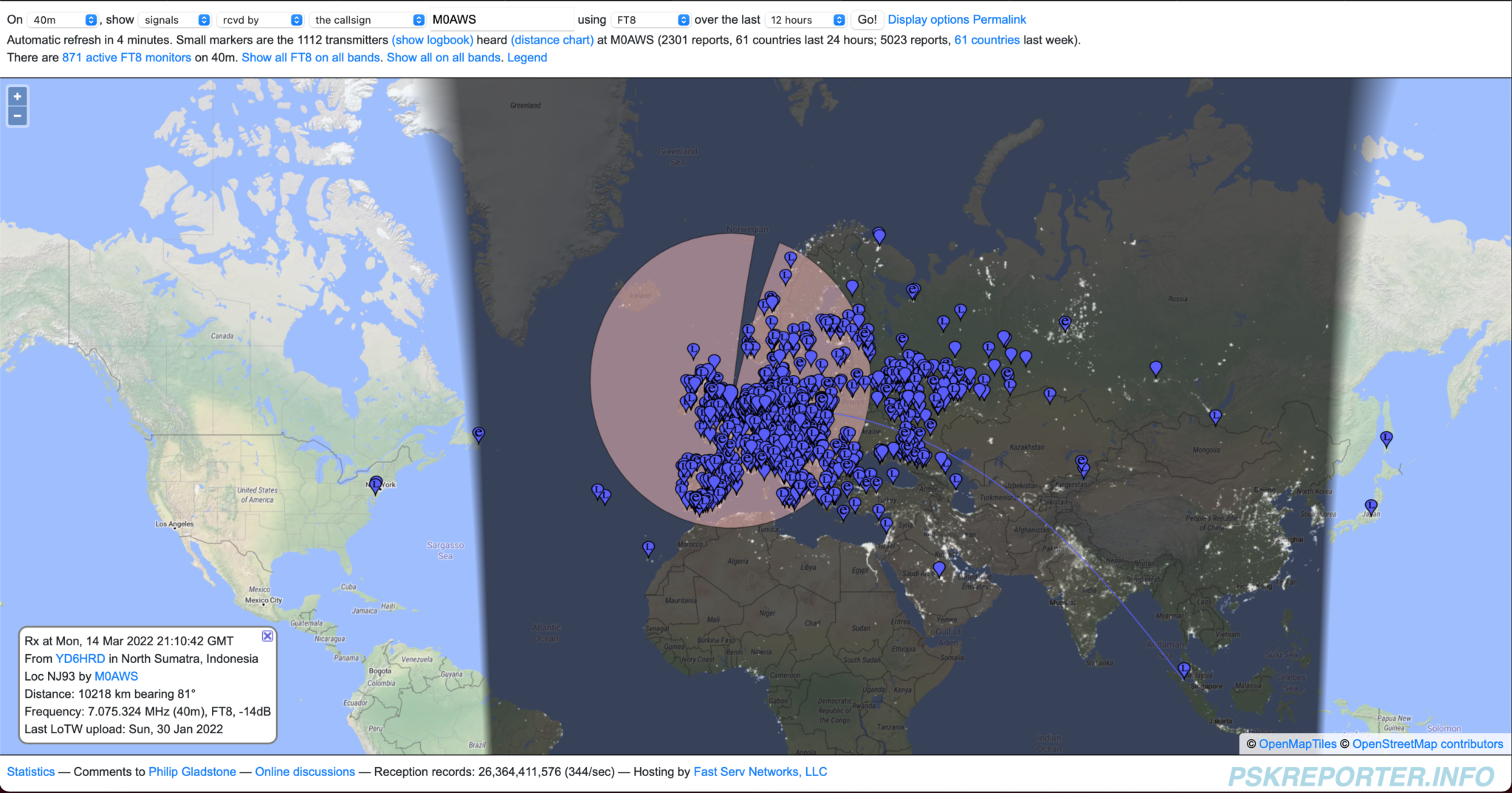
By the end of the evening to my surprise I had been heard in the USA, I was amazed to see where I’d managed to get into with such a low antenna. The main cluster of stations were in the U.K. and Europe of course which is exactly what I wanted from this antenna.

Stations that heard M0AWS on 40m FT8 using NVIS antenna

So the next test will be on the 80m band, I’m hoping to get similar results on SSB with inter-G stations being easy to work. I doubt I will be able to get anywhere near the 1500 miles I achieved on the 40m band but, I’ll be more than happy with U.K. and EU stations.

More soon …

Thoughts on a new antenna …

I’ve started thinking about antennas for the M0AWS QTH. Unfortunately we only have a typical U.K. sized garden now, which is tiny compared to the acres we had when we lived in France (F5VKM).

So, small gardens means small antennas.

The only direction I can go really is up, although most of my neighbours are very antenna unfriendly!

Like most radio amateurs in the U.K. I’m trying to find a single antenna that will give me the best performance possible on as many bands as possible.

Of course we all know there is no unicorn antenna that does it all but, with some compromise we can do fairly well on a mix of bands with a little consideration.

To this end I’ve been looking at Inverted L antennas. It’s not an antenna I have any real experience of but, it’s interesting to research.

40m End Fed Half Wave Inverted L

I started with a design for the 40m band. A simple end fed half wave inverted L antenna that consists of two parts. The vertical section is 11.95m high and the horizontal section is 8.7m long. Total length of wire is 20.65m. Modelling the antenna with 1.5mm wire it gives some surprising results.

3D Field Plot on 7.1Mhz
2D Field Plot on 7.1Mhz

As shown in the two field plots above, the antenna has an extremely low angle of max radiation making it ideal for DXing. Gain at 10 Deg is 3.99dBi, not to be sneezed at. The 3D plot shows the overall radiation pattern to be almost perfectly circular.

On the 20m band the antenna presents a favourable pattern considering it’s a full wave length long.

The angel of radiation is somewhat higher than on 40m but, this is to be expected.

2D Field Plot on 14.1Mhz

On the 20m Band the antenna gives a gain of 7.07dBi at 25 Deg. A higher angle of radiation than on the 40m band but, still very usable. At 5 Deg there is 4.29dBi of gain which makes it ideal for DXing.

3D Field Plot on 14.1Mhz

On the 15m band the pattern isn’t as good as on 40m & 20m however, it would still be usable.

3D Field Plot on 21.1Mhz
2D Field Plot on 21.1Mhz

With a gain of 6.04dBi at 25 Deg it should perform very well on the 15m band. At 10 Deg there is a gain of 1.12dBi. The overall pattern is a bit lopsided and it also has more high angle radiation than I really want but, like all multi band antennas there’s always a compromise.

Next I modelled the antenna on the 10m band, the 3D pattern is rather alarming but, it has potential.

3D Field Plot on 28.1Mhz

There’s a lot of high angle on the 10m band and a somewhat out of balance pattern but, there’s also gain to be had at a lower angle too.

2D Field Plot on 28.1Mhz

The main gain is 6.37dBi at 45 Deg, ideal for short hop communications however, there is 3.58dBi of gain to be had at 10 Deg, much better for DXing.

It’s not ideal for 10m by any means but, when you take into account that the antenna is 2 wave lengths long it’s hardly surprising.

I’ve still got a lot more work to do on this modelling but, it has huge potential.

I’ve not even started thinking about impedance matching yet, I know it’s going to be a monster and nowhere near 50 Ohms but, I’m sure a simple LC network will do magic with matching it to the transceiver.

More soon …