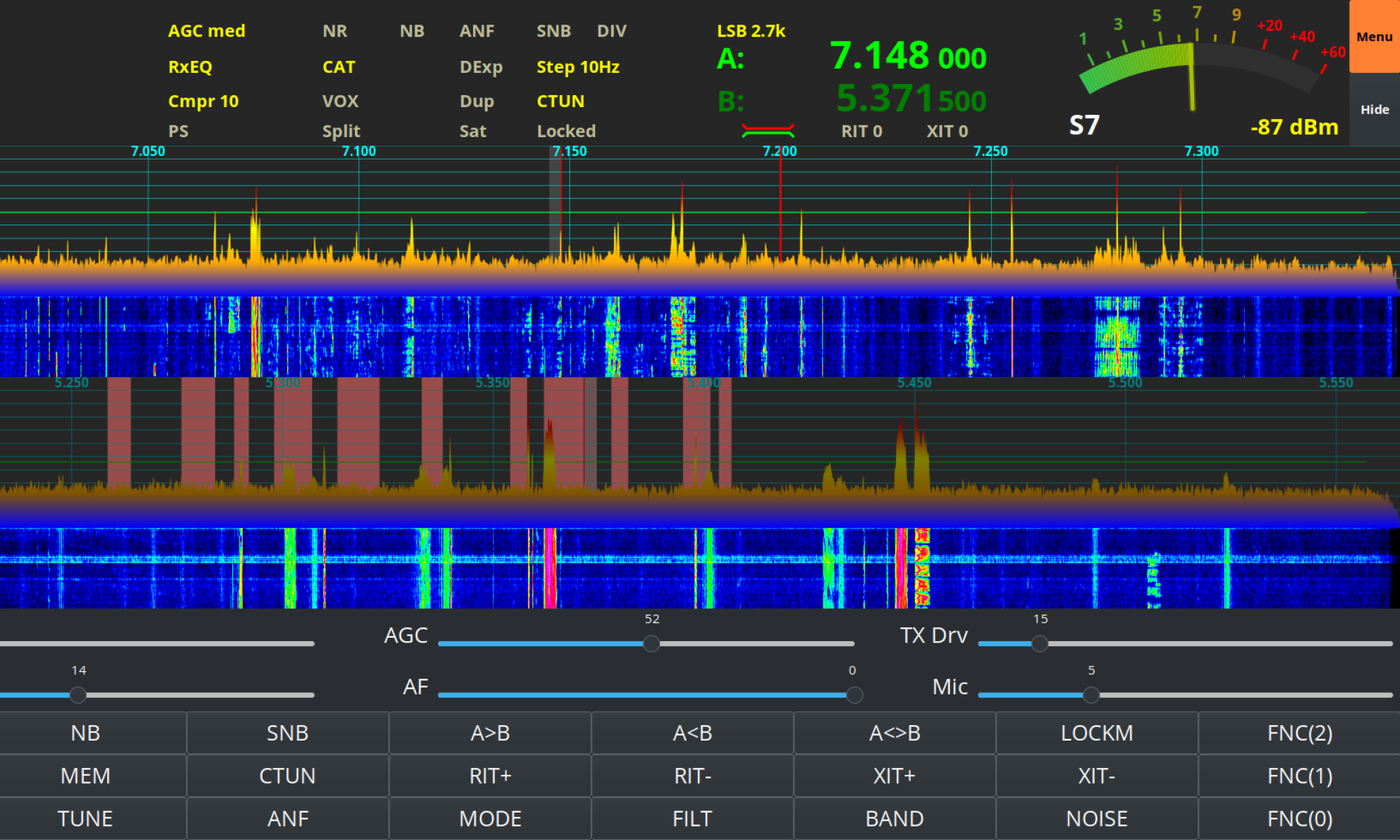
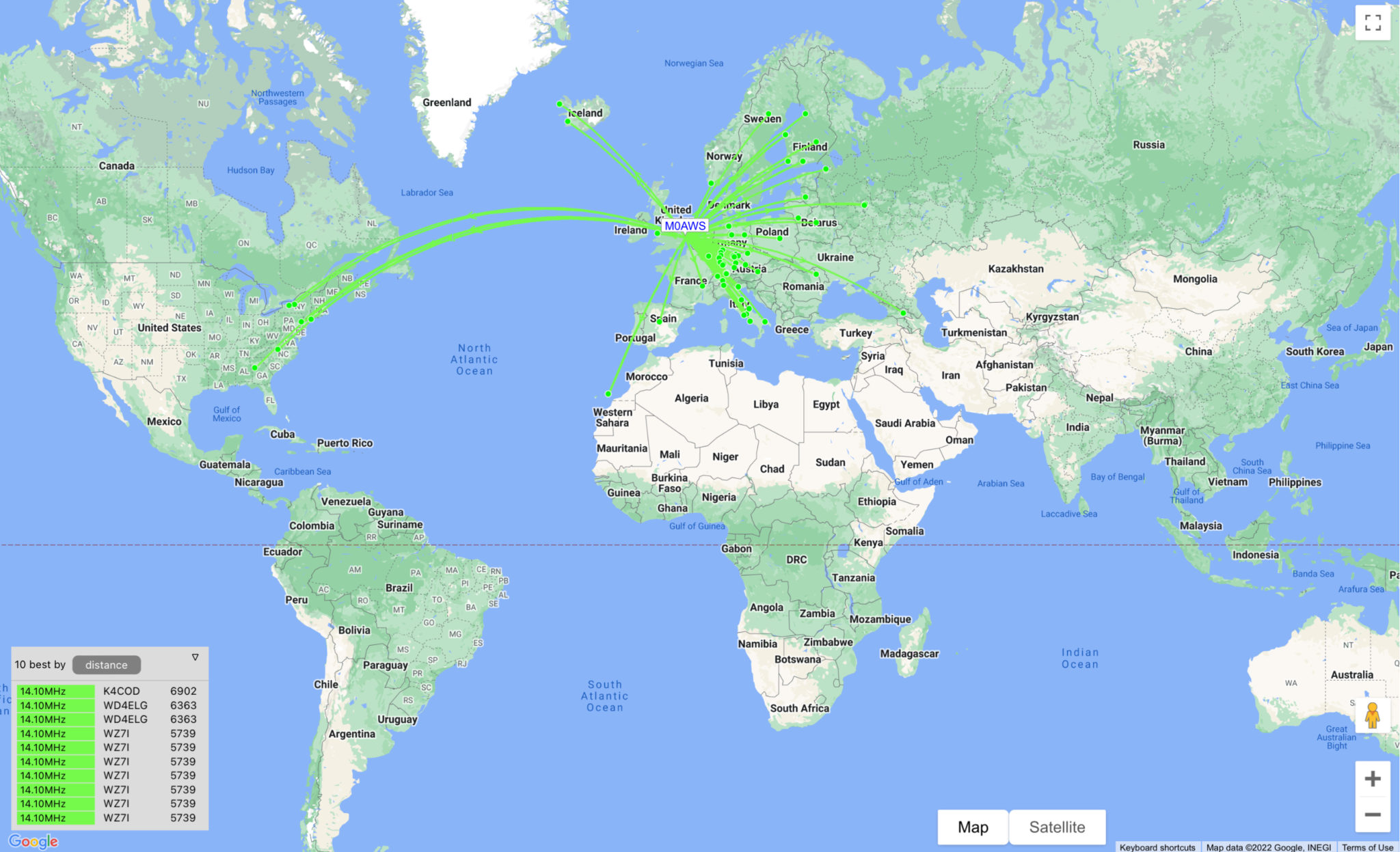
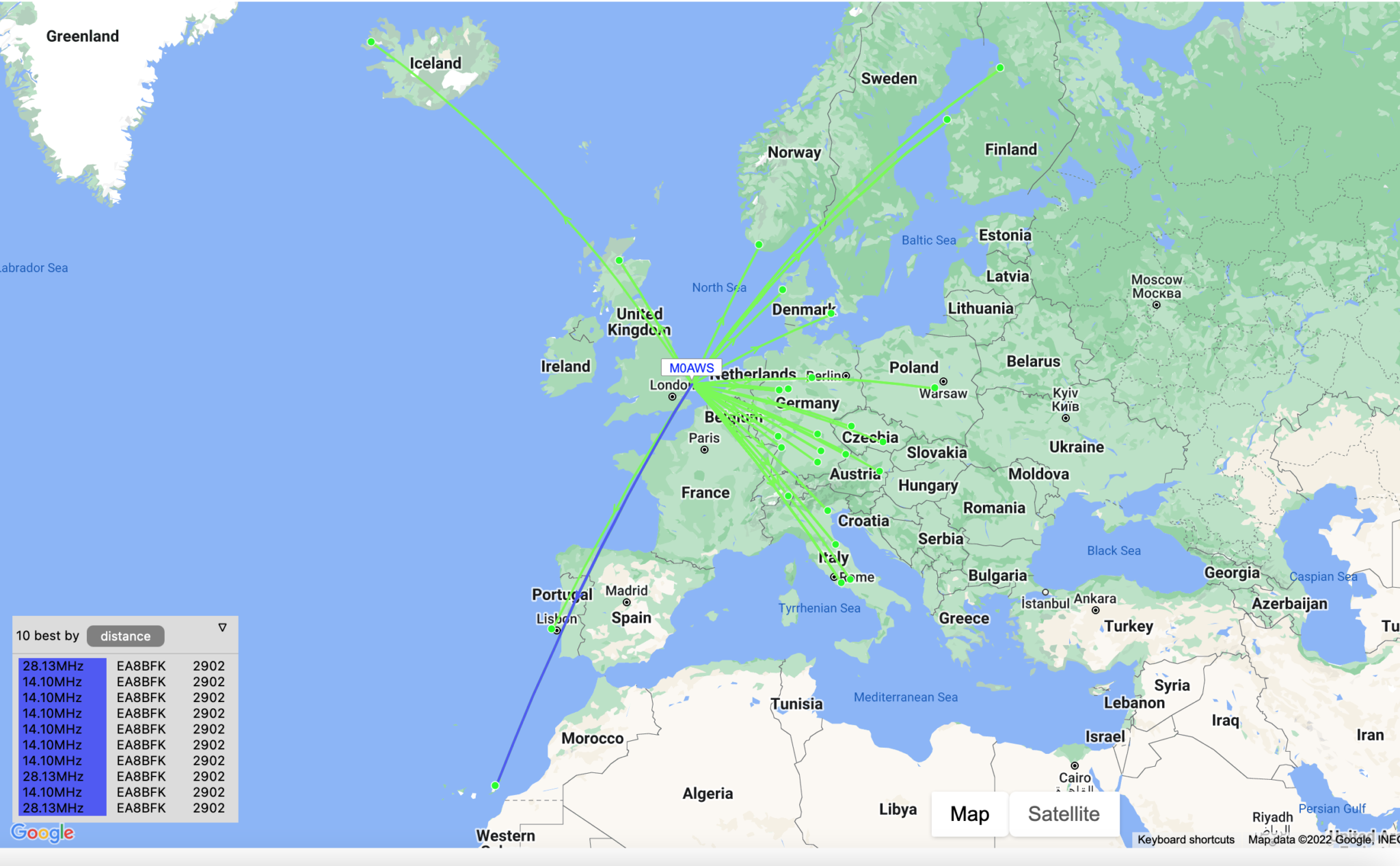
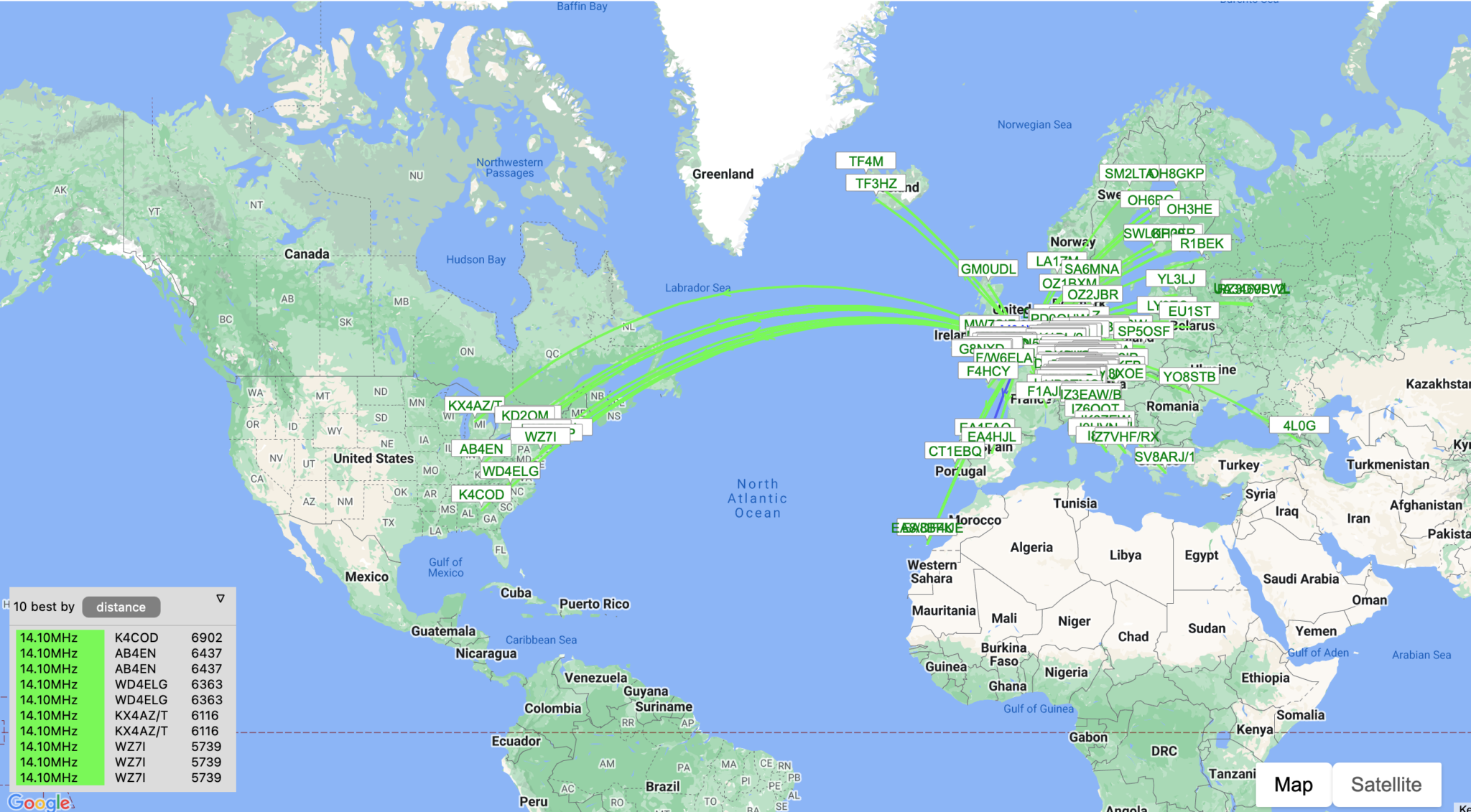
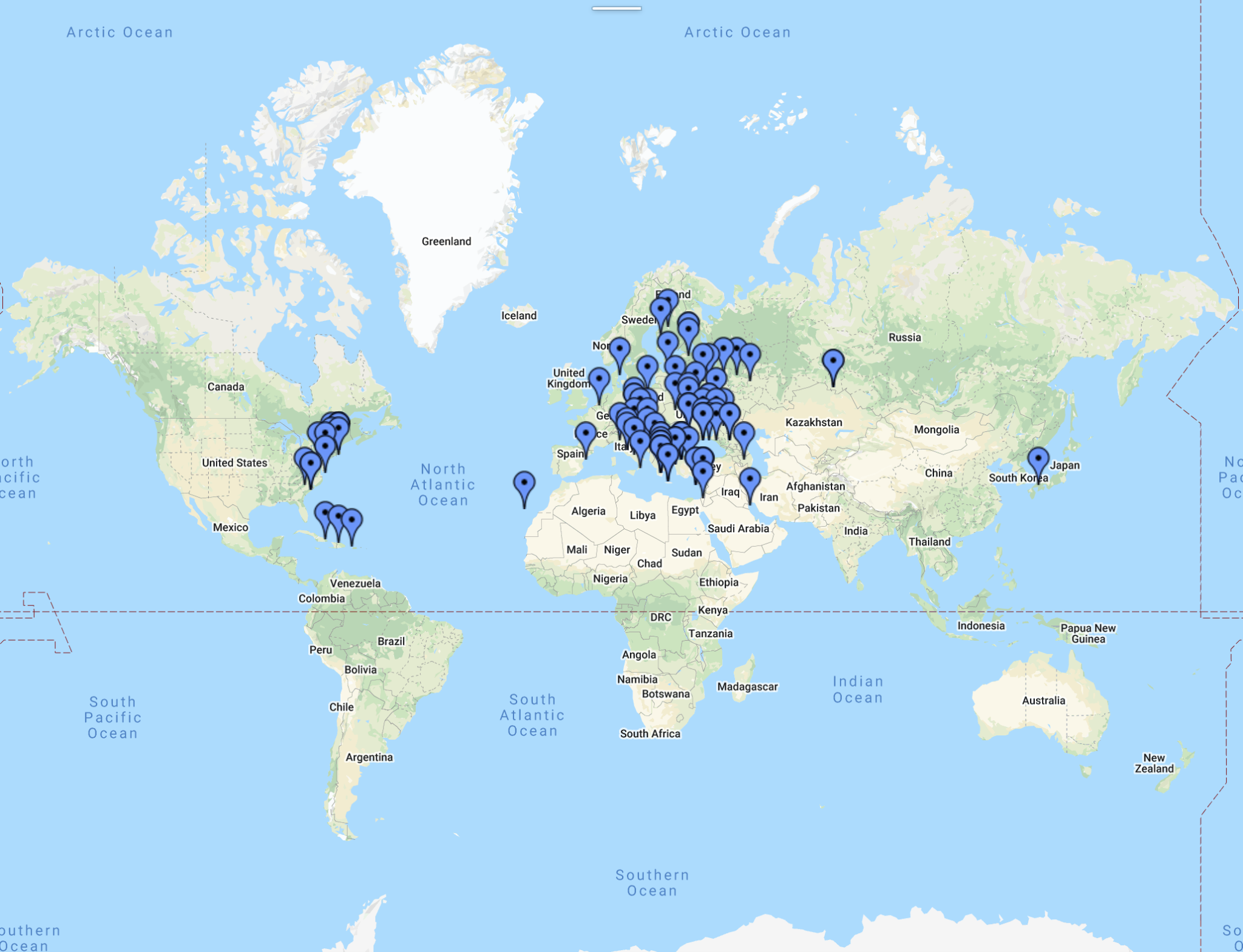
For the last 24hrs I’ve had the RaspberryPi2 transmitting WSPR on 20m and 10m connected to my EFHW Vertical antenna. So far not a single spot on the 10m band, I’m assuming the band hasn’t opened in the UK over the test period.
WSPR 20m band reports over the last 24hrs
Results on 20m continue to impress with reports from the USA, West Africa coast and as far east as Georgia.
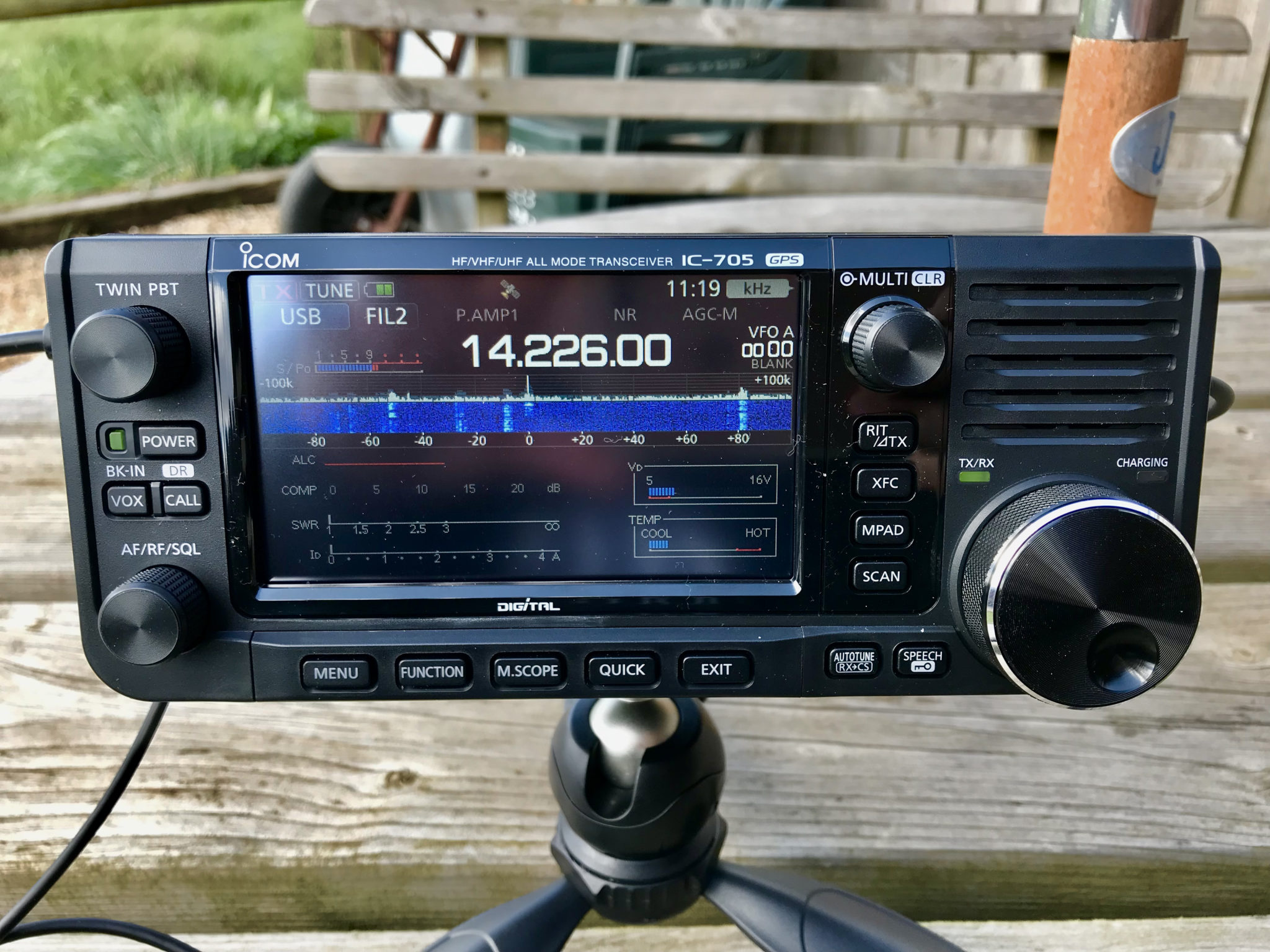
I’ll check the signal on 10m later today using my IC705 to ensure it is transmitting ok and then will leave it running for another 24hrs to see what happens.
UPDATE:
It appears there’s been a reliable opening on both 10m and 20m to the Canary Islands just off the west coast of Africa so far today.
Having just completed building my new radio shack I thought what better way to break it in than to do an all night radio session chasing the DX.
All nighters aren’t anything new for me, I did many an all night session low band DXing when we lived in France (F5VKM). Back then I had a massive cellar, part of which was a very well fitted out radio shack. With some very large antennas in our field out back I was truly spoilt with some great times on the 160m band in the dark winter months.
Now back in the UK and only just getting back into the hobby after a long break things are somewhat different. I now only have a typical small UK garden and only vertical antennas. Better than no antennas though!
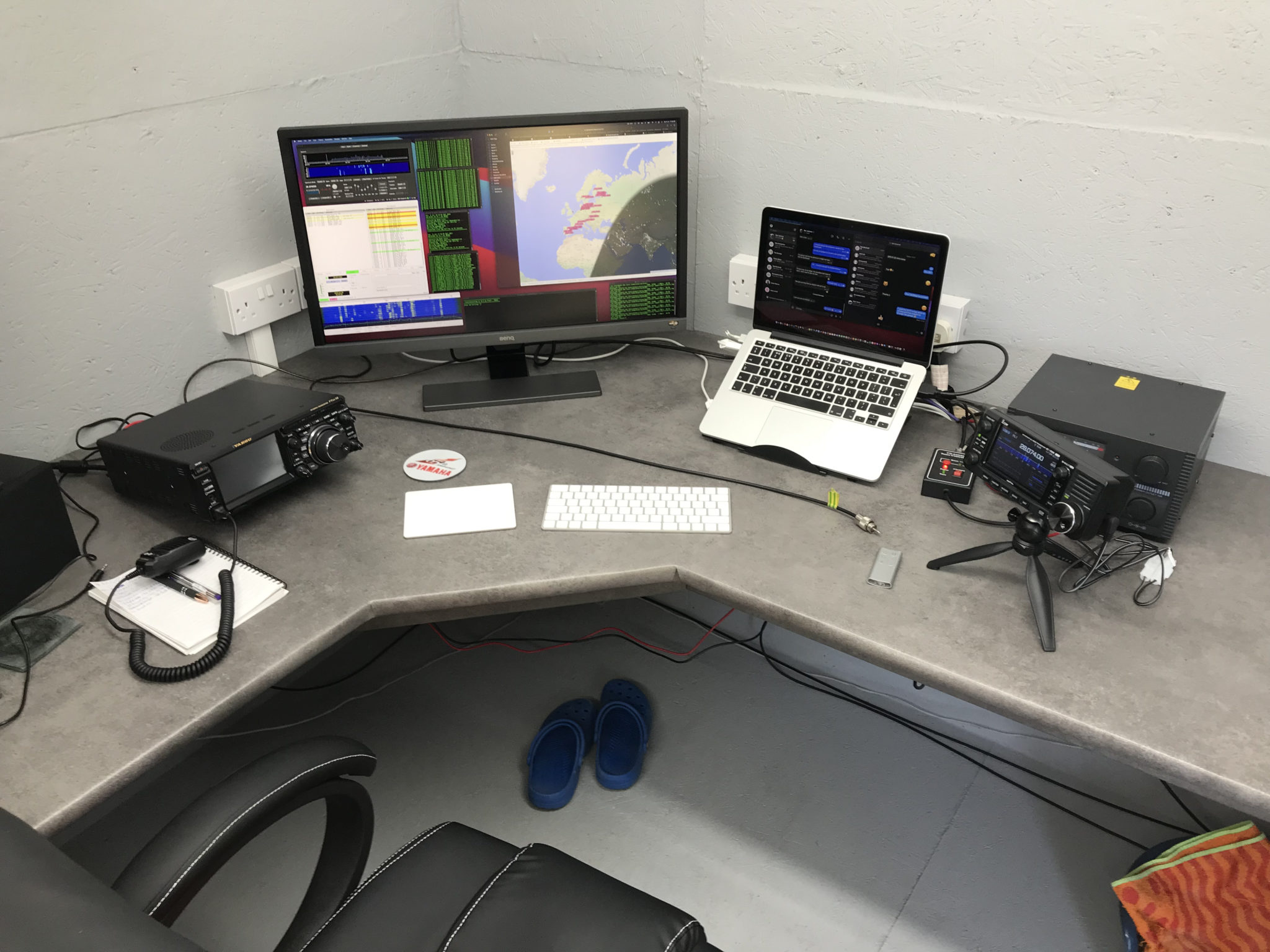
The new radio shack is small compared to my super spacious setup in France but, it’s perfectly formed with all facilities.
For my over night radio session I decided to use my trusty Yaesu FTDX10, it has the best receiver I’ve ever used and is built to withstand the long haul operation.
Antenna wise I decided to use my 30m band EFHW vertical that can be tuned on most bands from 80m and upwards. I use a CG3000 remote auto tuner to match this antenna to the 50 ohm coax feed and it does a great job.
Being comfortably setup in the shack I tuned up on the 30m band and had a listen to see what shape the band was in.
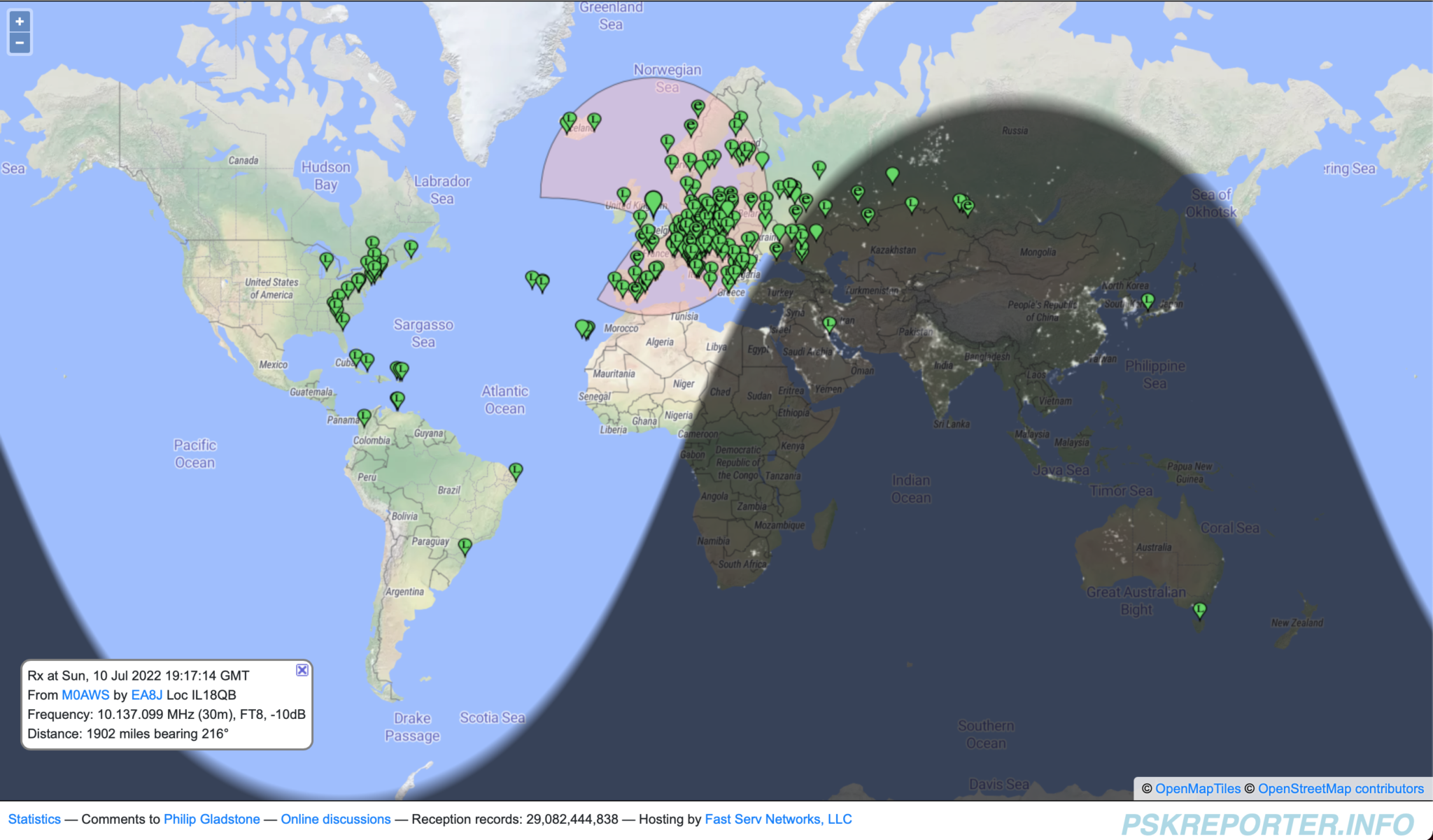
Stations heard on 30m 10/11-07-22
Using FT8 I worked a bunch of European, Russian/Asiatic Russian stations with ease, the band was in fairly good shape albeit localised around Europe and Russia. Wanting to work stations a little further afield I decided to move up on to the higher bands. 12m is a band I really like but, always seem to miss when it’s open.
Tuning up on the 12m band using the same vertical that I was just using on the 30m band the FT8 section was packed with signals. At last, I’ve tuned up on the band when it’s open!
I suddenly noticed Bobby, VP8ADR down in the Falkland Islands in the WSJTX waterfall and gave him a call. He had a fair few people calling him and so I joined the list. In no time at all Bobby answered my call and we exchange SNR reports of -8dB both ways. This was surprising as later on one of the FT8 Facebook groups Bobby stated he was using 200w into a Hexbeam during our QSO, I was only using a measly 18w into my Vertical, I would had expected a much lower SNR report. Clearly Bobby’s setup was doing all the work!
Right after the QSO with Bobby I immediately went on to work PY7ZC, LU8YD, PY2ATI, LW6EQC, PY2EBD and PY2THO all in quick succession. With the Falklands, Brazil and Argentina in the log so soon it was looking like it was going to be a fun packed night.
Next up on the waterfall was 9Y4DG in Trinidad and Tobago and 8P6ET in Barbados, two really nice locations to get into the log and new ones on 12m for me.
Having worked all the DX I could hear on 12m and not wanting to just spend hours working endless European stations I tuned down onto the 17m band using the same vertical antenna. This antenna really does work well on bands it’s not designed for.
First 3 stations in the log on 17m were all from Japan, JR3NZC, JQ6RUP and JA5BDZ. With all 3 stations being well on the way to 6000 miles away this was a good start. The propagation strangely swung to the west and I got YV5DRN from Venezuela in the log.
Not seeing any other stations that I wanted to work I retuned back onto 30m again and found it was open to South America and the Caribbean.
In no time at all I had YV4CLF in Venezuela, HK2AQ in Colombia, NP4TX and NP3XF in Puerto Rico and PY7ZC in Brazil all in the log.
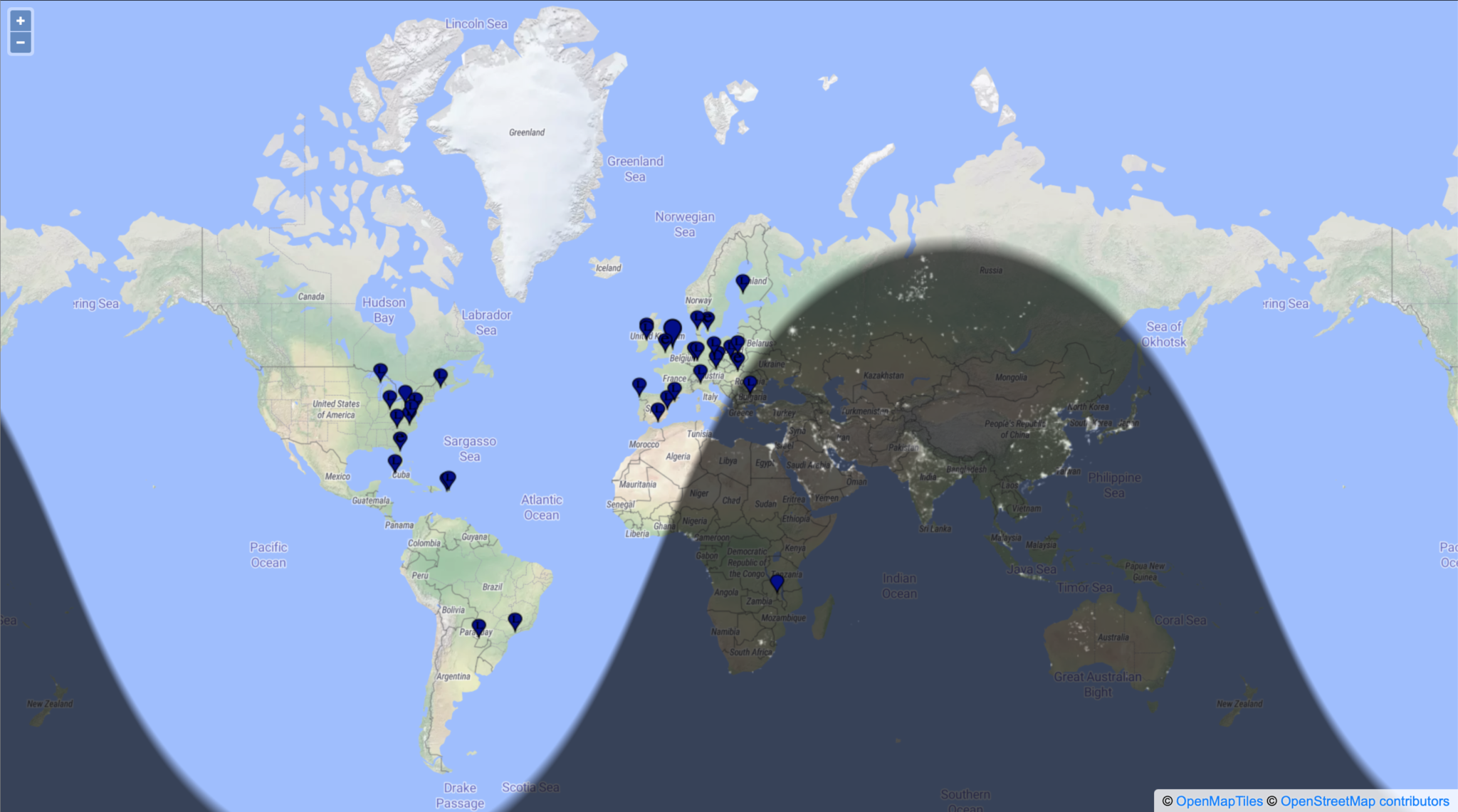
Being in complete darkness I decided to tune down on to the 60m band, one of my favourites, to see if there was much going on. Sure enough there were a few stations active on the limited space available.
First station worked was a new one for me FP/KV1J on St. Pierre and Miquelon Island just off the coast of New Foundland. I have to admit I had no idea where this little island was and confess to having to look it up on google maps.
I then went on to work a few East Coast USA stations all with good SNR reports for this time of year.
Stations heard on the 60m band 11-07-22
Having worked all the notable DX on 60m I tuned back onto the 17m which was now wide open to the world.
I stayed on this band for the rest of the night well into the morning grey line and beyond working some great DX including some new ones for me.
I worked many East Coast USA stations but, stations of note were 6Y5HN in Jamaica and AK6R, K6EU and K6EI in California on the West Coast USA. It’s rare for me to get into the West Coast USA for some reason.
UA0SDX in Irkutsk Siberia was also a nice one to get in the log. This is a town I was going to be riding my motorcycle through on my Mongolian trip before COVID19 and the war in Ukraine broke out and stopped the trip from happening.
It was good to get an Ozzy call in the log too, VK6EI on the West Coast of Australia came in at a strong -15dB SNR giving me a surprising -14dB SNR report, incredible considering I was using just 22w into my vertical antenna.
Well after sunrise the DX was still pouring in and I worked KL7TC in Fairbanks Alaska, a new one for me that made me very happy as I’d been trying to get into Alaska for some time but, never seemed to time it right. Today was my day!
Another station I was really pleased to get into the log was V31MA. I’ve tried to get a QSO with this station many times but, have never succeeded until today. I called for about 20mins and eventually got a reply putting a huge smile on my face. -16dB SNR sent and -19dB SNR received, I was happy that I finally have Belize in the log.
The last station worked was RA0FF way over on the far East Coast of Russia, the complete opposite direction to Belize. Located in Yu-Sakhalinsk right on the Russian coast opposite Japan and at 5270 miles, this is my longest distance Russian station worked so far and one I was very happy to have in the log. I always get good take off towards Russia whether it be directly east or over the North Pole to the far eastern parts of the Siberian wilderness.
I had a great night chasing the DX on the HF bands and being retired didn’t have to worry about going to work after such a long night. I highly recommend that you try an all nighter at least once in your HAM radio career, you get the opportunity to work stations that you’d normally not hear during the day time hours.
You can see the full list of stations worked on the over nighter on my WSJTX Log page.
Now that I’ve got my new radio shack up and running I decided to give my Icom IC-705 QRP rig an outing and see if I could work a distance of 2000 miles with 1w output.
This is something I’ve been wanting to do for a while but, only being able to sit at the picnic table in the garden or in the summer wasn’t particularly conducive to a long stint on the radio.
Icom IC-705 wirelessly connected to my MacBook Pro
For this challenge I decided to use FT4 or FT8, whichever was active on the bands. This is a great mode for QRP operations and can get a tiny signal through when other more traditional modes fail.
I used both my EFHW vertical for 20m/10m and my EFHW vertical for 30m that can also be tuned on most of the other HF bands too. This gave me most of the HF bands for the challenge.
Initially I worked a lot of stations in the 600-700 mile range, conditions weren’t brilliant and there was a lot of deep QSB.
My first notable distance QSO was with YO4DG near Mangalia Romania at 1383 miles, this equates to 0.72mW/Mile, my lowest mW/Mile achievement up until this point.
Not long afterwards I saw SV8DCY on the WSJTX waterfall, I wasn’t sure if he’d hear me or not but, I gave a call. To my surprise he came back and became the longest distance QSO for a short time. At 1485 Miles to Kalloni Lesvos Island, Greece this equates to a new low of 0.67mW/Mile.
I then went on to work a bunch of stations in the 1000 miles or less range for a while as conditions on the bands were up and down. It’s amazing how many times I got an answer from a station only for them to disappear completely before the QSO was completed.
The next contact of note was with CU3HN in the Azores, 1713 Miles at 0.58mW/Mile, a new lowest mW/Mile record set. it’s amazing how far you can get a signal with such a tiny amount of power.
RV6F in the Stavropol region of Russia was the next big mile marker, 1932 miles at 0.51mW/Mile. It took a number of attempts to get the QSO to complete as we kept losing each other due to the deep QSB that was between us on the 20m band but, with a little patience and persaverance we eventually got the QSO to complete and it was in the log.
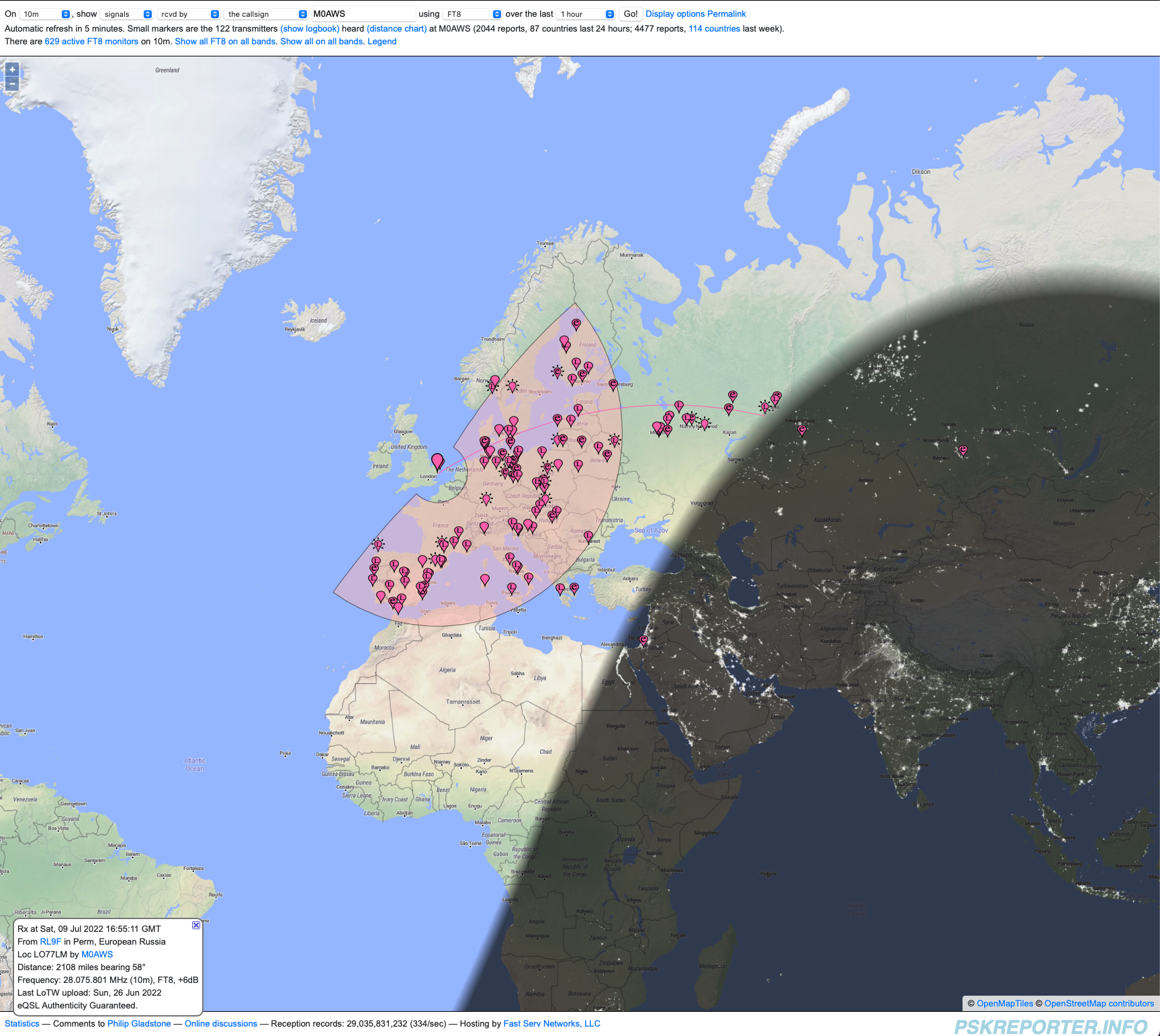
At this point I decided to switch over to the 10m band to see if it had opened up to more than just Europe. When I checked earlier there were only European stations being heard, most being well under 1000 miles. Sure enough the band had indeed opened up and I was hearing stations out to the east that were in excess of 2000 miles.
PSKReporter map showing signals heard on the 10m band
After tuning up and listening for a bit my first call was to RL9F in Perm Russia. This was the one that I’d been looking for, 2084 miles at 0.47mW/Mile this was the one that could complete the challenge.
After a few failed attempts due to deep QSB we eventually got a complete QSO in the log finishing the challenge.
2000 miles using 1w is a lot of fun, frustrating at times when you’re being heard by stations on the east coast USA but, none are answering your reply to their CQ calls.
PSKReporter has proven invaluable, being able to see who can hear you makes a big difference when trying to eek out the last mile when using next to no power.
In total 31 stations were worked over a 9 hour period, not huge numbers but, for many an M0AWS call sign isn’t exotic enough to answer and so many of my calls to stations were ignored. Sad really.
You can view all the log entries for the 2000 Mile 1 Watt challenge on my WSJTX Log.
So, what next? Well I guess it has to be 3000 miles or more using just 1w from my trusty Icom IC-705.
I spent the evening/early morning trying some FT8 on the 40m band taking advantage of the grey line and night time propagation. It’s been a while since I’ve stayed up late to catch some DX on 40m and it brought back memories of the all nighters I used to do when I was on air as F5VKM in France.
The 40m band has always been one of my favourites, there’s always great DX to be had when the band is open and on the grey line the world really is your oyster.
I’ve always been a huge fan of CW on 40m, there are some great seasoned op’s on the band and it’s always a real pleasure to QSO with them on the key. This time I decided to see what could be achieved with FT8 and 22w of power from my Yaesu FTDX10, a combination that should give me global reach.
Setting up at just past 6pm on May 9th 2022 the band was already busy with European stations, lots of them! There was no room to squeeze in and call CQ, the FT8 section of the band was packed with signals filling the allocation completely with many calling over the top of each other.
I decided to take my normal stance of search and pounce to get the stations I want to work rather than just working the masses endlessly.
I initially worked a bunch of Russian stations ranging from 1200 to 2200 miles out, good distances were easily achievable even though we were still in full daylight.
My home-brew multi-band vertical antenna worked well on 40m
In amongst the throng of FT8 stations I spotted UN3P, Vladimir in Karaganda Kazakhstan, not a country I have worked a lot since getting back on air and at 3013 miles it’s a good distance to achieve on 40m whilst still in broad daylight.
I gave a call to his CQ and he came straight back with an SNR report of -20dB, I sent him a report of -12dB so there was some 8dB difference between us. Considering I was only using 22w of power in broad daylight I was happy with the report. Of course I’ve no idea how much power he was using but, my signal was 6.63mW/Mile, not the lowest I ever had but, not the biggest either.
I worked a bunch more RA9/UB9 stations in the 2000-3000 mile range and then started hearing the Australian stations on the early grey line. Initially their signals were suffering some deep QSB but, it wasn’t long until their signals were constant and stable.
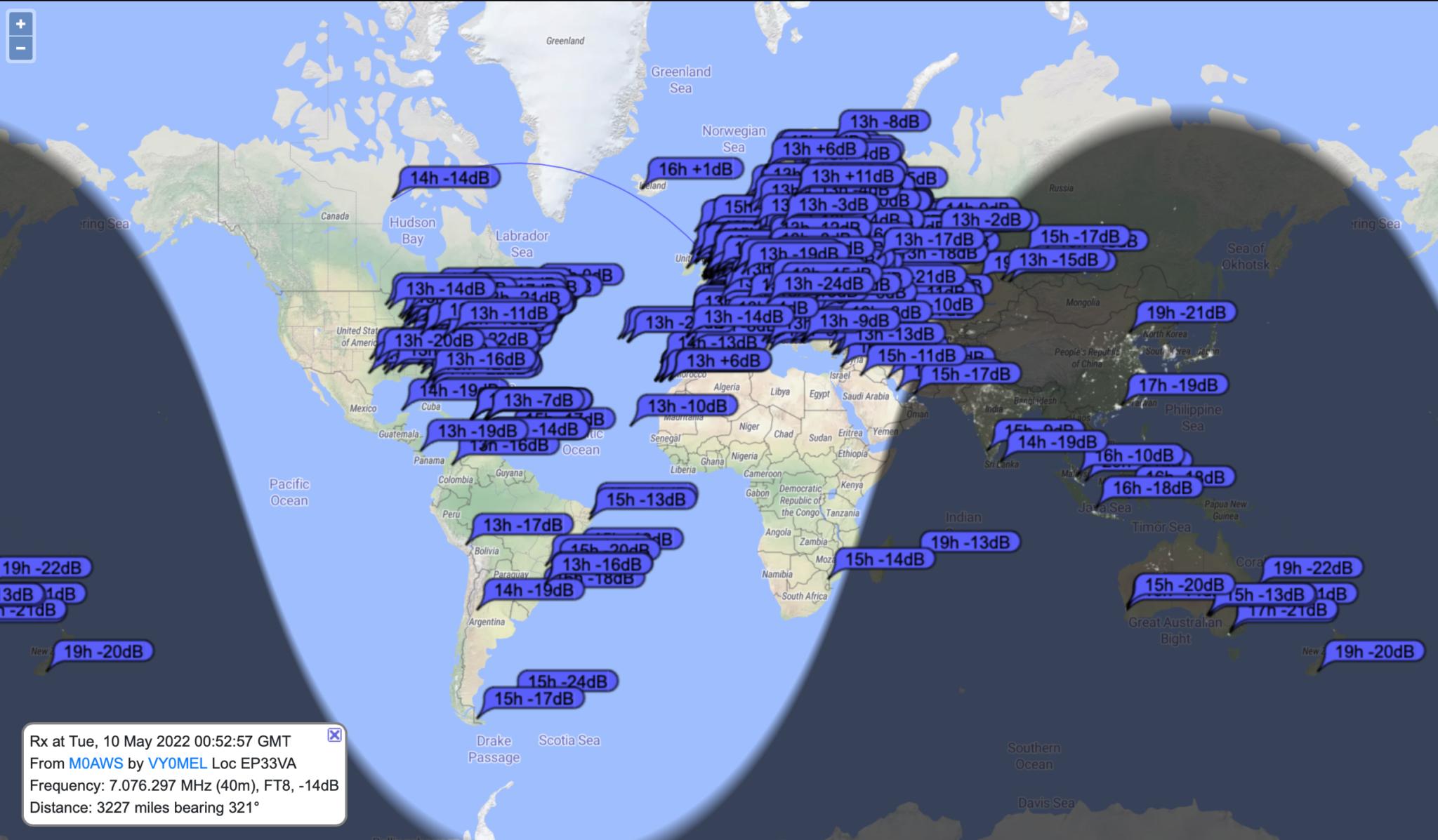
All the stations that heard M0AWS 09/05/22 – 10/05/22 on 40m
Ian, VK3VDX in Victoria was the first station from Oz in the log at -19dB/-20dB, pretty even SNR reports. At 10451 miles it equates to 2.10mW/Mile.
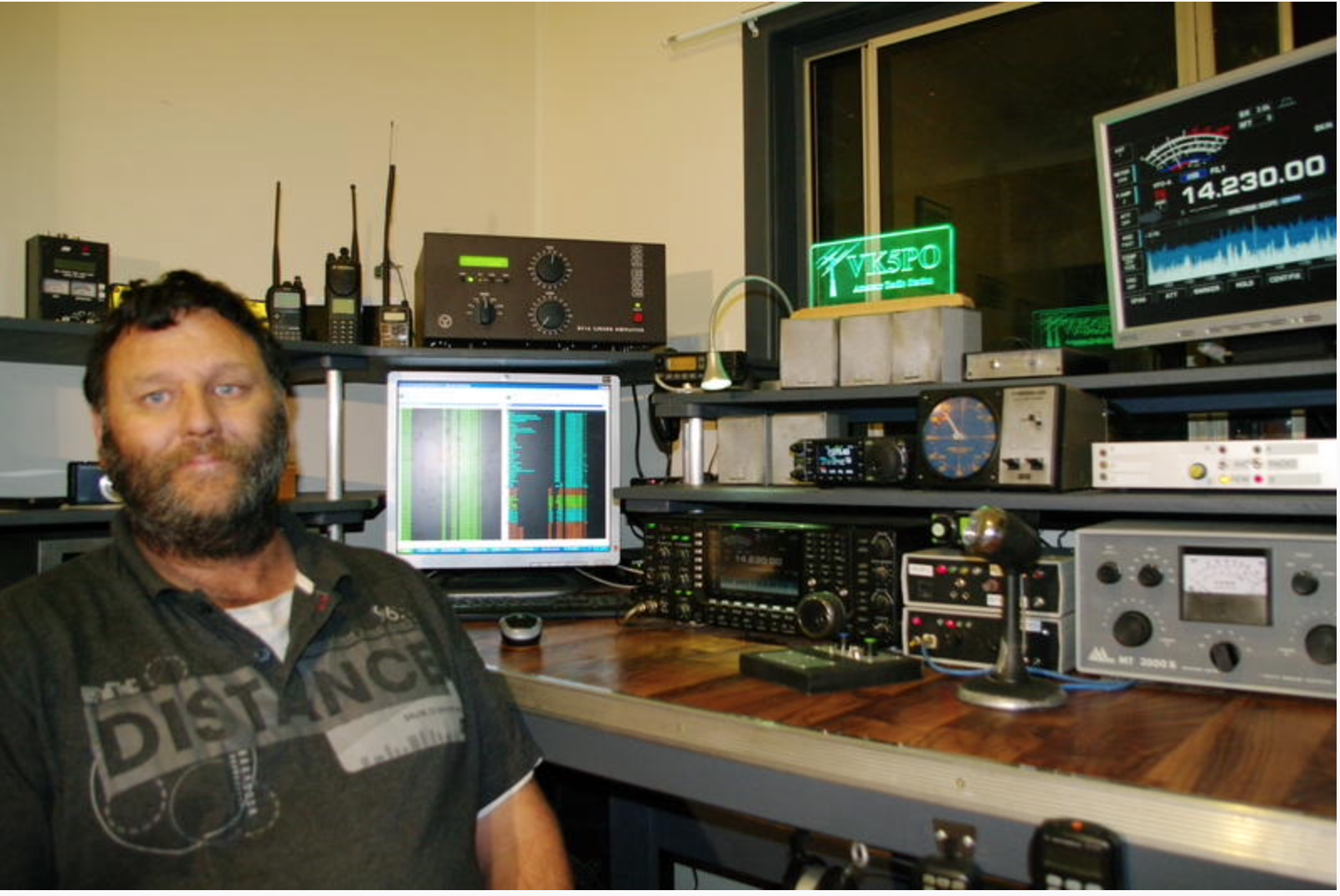
Closely following was John, VK5PO in Mallala South Australia, much stronger signals this time at -10dB/-14dB, 2.19mW/mile over a total distance of 10028 miles.
VK5PO Mallala South Australia
As darkness replaced light the propagation swung west with east coast USA and Canadian stations dropping in to the East coast of the U.K.
John, VO1BE was the first north American station in the log with -1dB/+1dB SNR reports. To be +1dB in Canada with just 22w really is quite impressive. I’m guessing he has a very low background noise level.
I worked a bunch of East Coast USA stations and then PY2GZ popped up on the waterfall. From my QTH I have a clear view South East to South West across flat ground for miles and so it’s normally pretty easy to work stations in that zone and this evening was no different. First call was answered and -10dB/-17dB SNR reports were exchanged, 3.68mW/mile over 5965 miles.
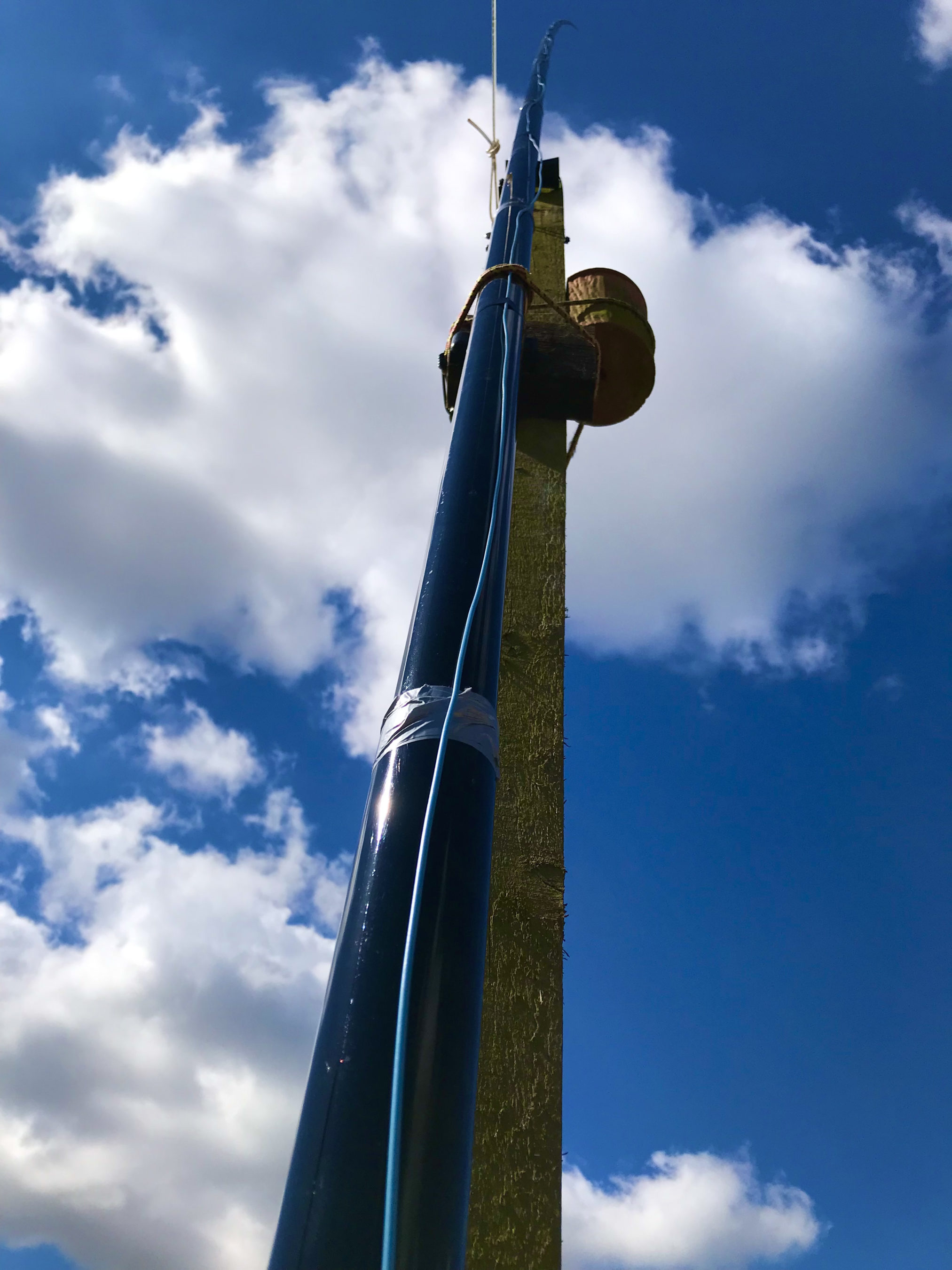
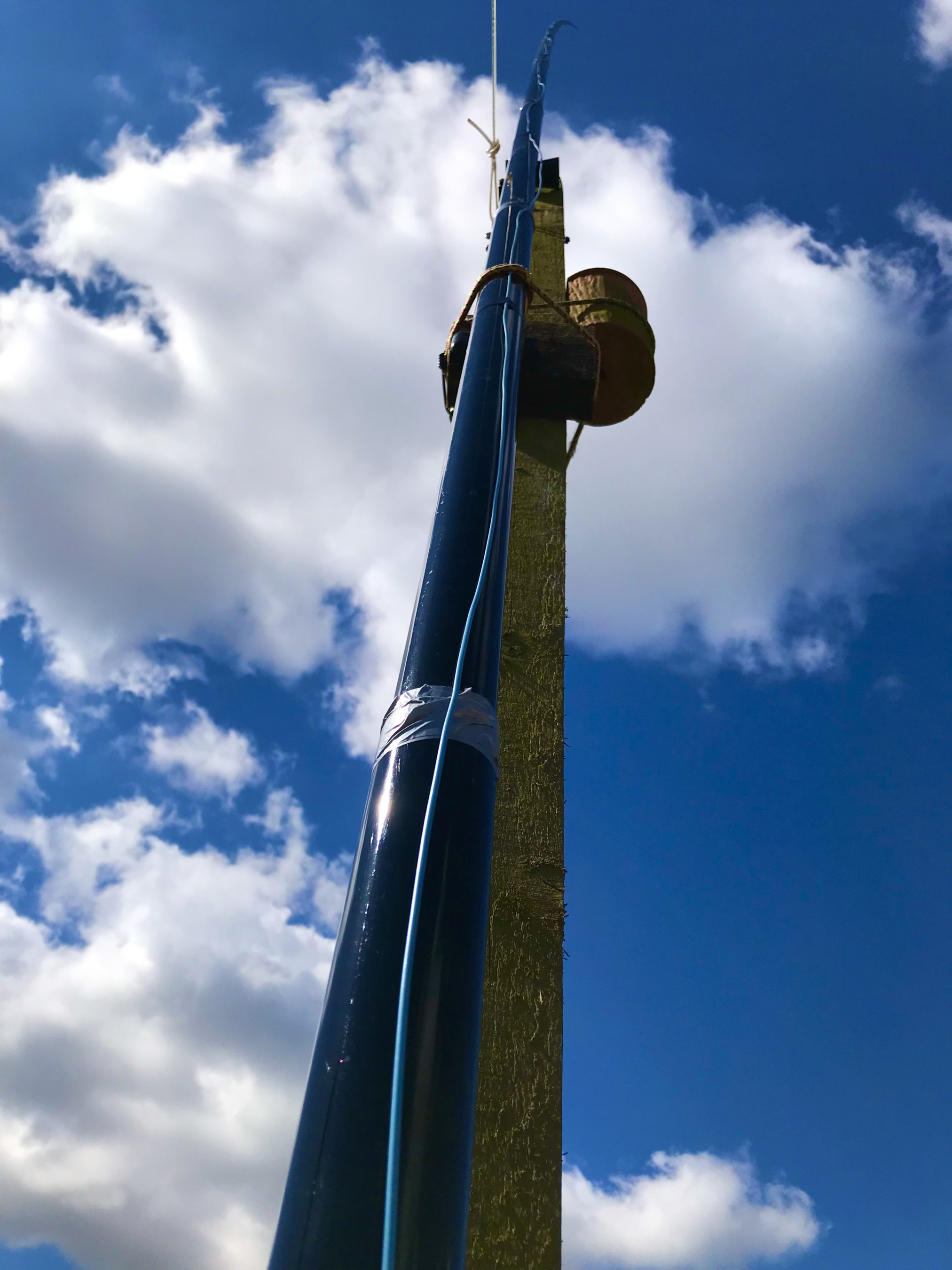
My 14.81m tall home brew vertical works superbly on the 40m band with tuning handled by my CG3000 Remote Auto Tuner. This is actually my 30m band EFHW vertical antenna but, removing the 49:1 Unun and replacing it with the CG3000 has made this antenna much more versatile.
CG3000 Remote Auto Tuner connected to the 14.81m vertical antenna and ground system
The next station in the log was BG0BBB in Xinjiang China with -9dB/-18dB SNR reports exchanged. China is always a hard location for me to get into for some reason so, I was glad to get another Chinese HAM into the log.
BG0BBB Xinjiang China
As the propagation started to swing westerly I got 8P4JP in Bridgetown Barbados into the log. It took a few calls to get the exchange completed due to very deep QSB between us but, with some perseverance the contact was completed successfully and I had a new one in the log!
I continued to work a flurry of East Coast USA, Brazilian and Puerto Ricon stations one after the other until suddenly stations from the east started coming in again.
First from the east was Igor, 4L1FL from Tbilisi Georgia, another new one for me that somehow seems to escape me every time I come across Georgian stations on the bands.
4L1FL Tbilisi Georgia
UN7JO in Ust-Kamenogorsk Kazakhstan was loud with me at -5dB SNR although I only got -21dB SNR back, some 16dB difference across the path of 3386 Miles.
One station of particular interest was VY0MEL, Julien in Rankin Inlet, Nunavut Northern Canada. This is the most northern Canadian station I’ve worked in a long time and it was great to get him in the log. His QRZ page is worth a read, he works at a mine in Nunavut on a 14 day rotation and so has a fair bit of time for HAM radio. Using just a dipole that is strung between two shipping containers and only 60cm above the snow in the centre he was a good signal at -19dB here in the U.K, especially considering he was still in broad daylight.
VY0MEL Rankin Inlet, Nunavut Northern Canada
Needless to say I had a fun filled evening/early morning on the 40m band, once again it didn’t disappoint and I got a couple of new countries in the log. I think the next late night will have to be a CW evening on 40m to see how well I do in comparison.
The full list of stations worked over 9th-10th May 2022 using FT8 on the 40m band can be viewed in my WSJT-X log in glorious technicolour with distances and mW/mile figures for every contact.
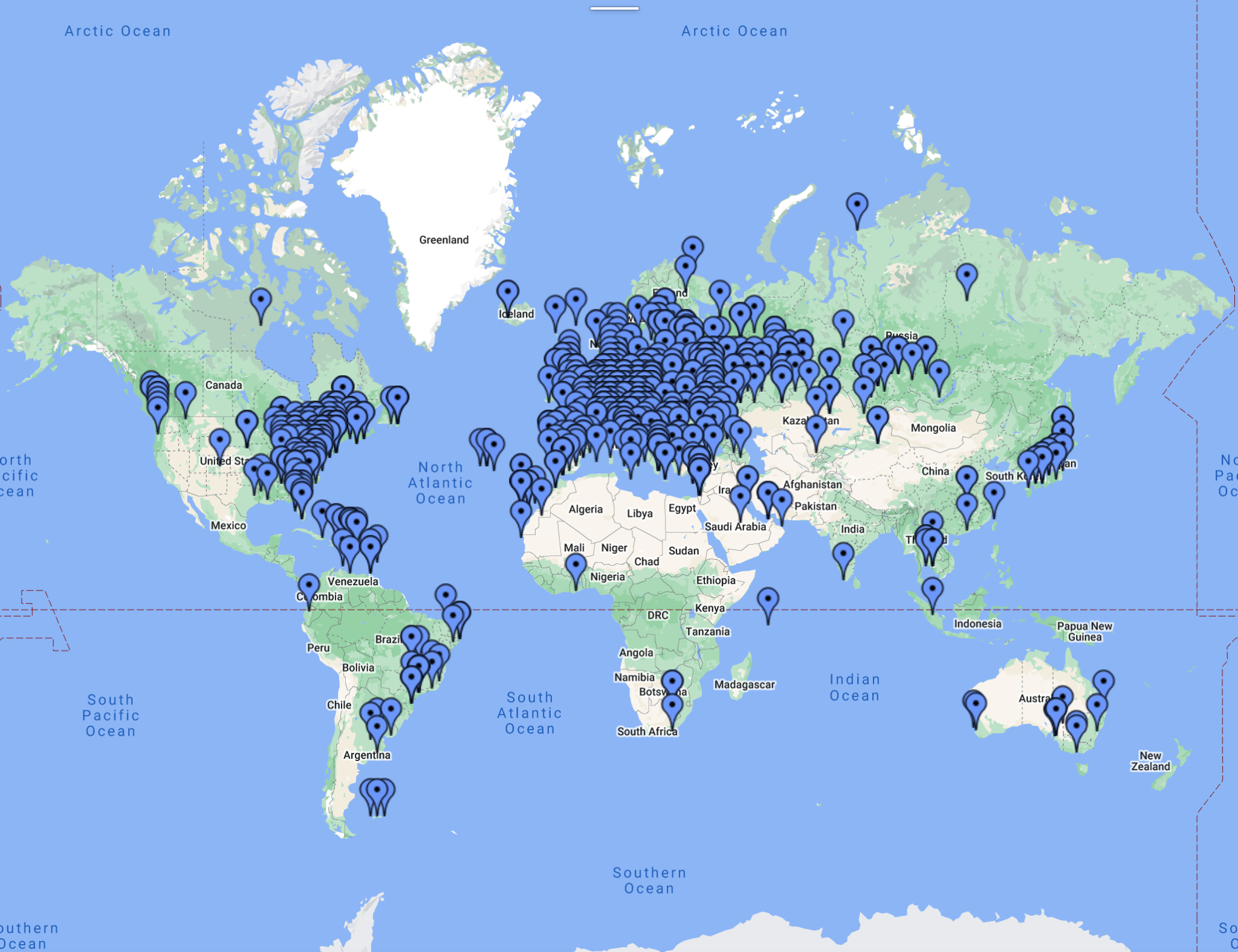
Map showing all FT4/FT8 stations worked up to 10/05/22 all bands
I spent some time this morning in the garden with the Icom IC-705/AH-705 combo connected to my End Fed Half Wave (EFHW) vertical for the 30m band. This is a great antenna that works superbly on the 30m band. Being a resonant half wave fed via a 49:1 Unun it doesn’t require any ATU inline normally and so it’s quick and easy to use with any radio.
Today I decided to disconnect and remove the 49:1 Unun and hook up the Icom AH-705 instead. I thought it would be an interesting exercise to see how well it handled the EFHW vertical on both 30m and the other bands.
Icom AH-705 connected to the 30m Band EFHW Vertical Antenna
I purchased a couple of 5m leads for the AH-705 so that I could setup the radio on the picnic table in the garden and be a comfortable distance from the antenna. They worked great and allow me to use the radio in the spring/summer sun with ease.
Icom IC-705 setup on the picnic table in the garden
The little AH-705 remote auto ATU really does work well with the IC-705. Each time you change bands all you have to do is give a quick press of the PTT on the mic and it automagically goes into tune mode and matches the antenna to the 50 Ohm radio in seconds.
I was was really pleased to see that the AH-705 ATU matched the EFHW Vertical for 30m on the 80m, 60m, 40m, 30m and 20m bands with a perfect 1:1 SWR. With the antenna consisting of 14.81m of wire this makes it somewhat short of a 1/4 wave on the 80m band and I’m not too sure how well it will work. On the 40m band it is a 3/8 wave antenna so should work well. It’s a 1/4 wave on the 60m band and of course a half wave on 30m band as per it’s original design. On the 20m band it is just under 3/4 wavelength long so hopefully should work reasonably well. Of course it won’t be as good as my 20m band EFHW Vertical that has a much lower angle of radiation but, will make an interesting comparison.
The antenna also tunes up nicely on all the other higher bands including the WARC bands. On 17m it is getting close to a full wave length and on 15m it is just over a full wavelength and so should work fairly well on these two bands albeit with a higher than optimal angle of maximum radiation.
On the 12m band it is 1.25 wavelengths long and of course on the 10m band it is almost 1.5 wavelengths long. I’m not sure how well it is going to work on these two higher bands but, for a 14.81m long piece of wire it certainly gives me a good chance on a wide spectrum of frequencies.
30m Band EFHW Vertical Antenna in the breeze
The bands weren’t in particularly good shape this morning but, I found some SSB signals on the 20m band and so decided to see if I could make some contacts.
First contact was with S51DX in Slovenia. He was using 1kw into a 5 element beam pointed pretty much directly at me. The little IC-705 S meter took a pounding with him peaking +30db over S9 most of the time. I was really pleased to get a 5/9 report from him using just 5w from the IC-705 on the standard 7v battery. Of course his station was doing all the work but, it’s good to take advantage of these big stations when running QRP power levels.
Next I had a QSO with John, EA7JUR in Almeria Spain. But this time the battery on the IC-705 was pretty much exhausted and so I hooked it up to the 12v supply to get it charging whilst I was on air. This of course gave me the ability to increase my O/P power by 100% to a massive 10w!
I wasn’t so strong at John’s end, only getting 5/5 report at best whilst he was 5/5-5/9 with me with some QSB. John was using a mini beam antenna again pointed towards me so once again all the work was being done at his end. We had a good chat for a number of minutes until it was time for lunch.
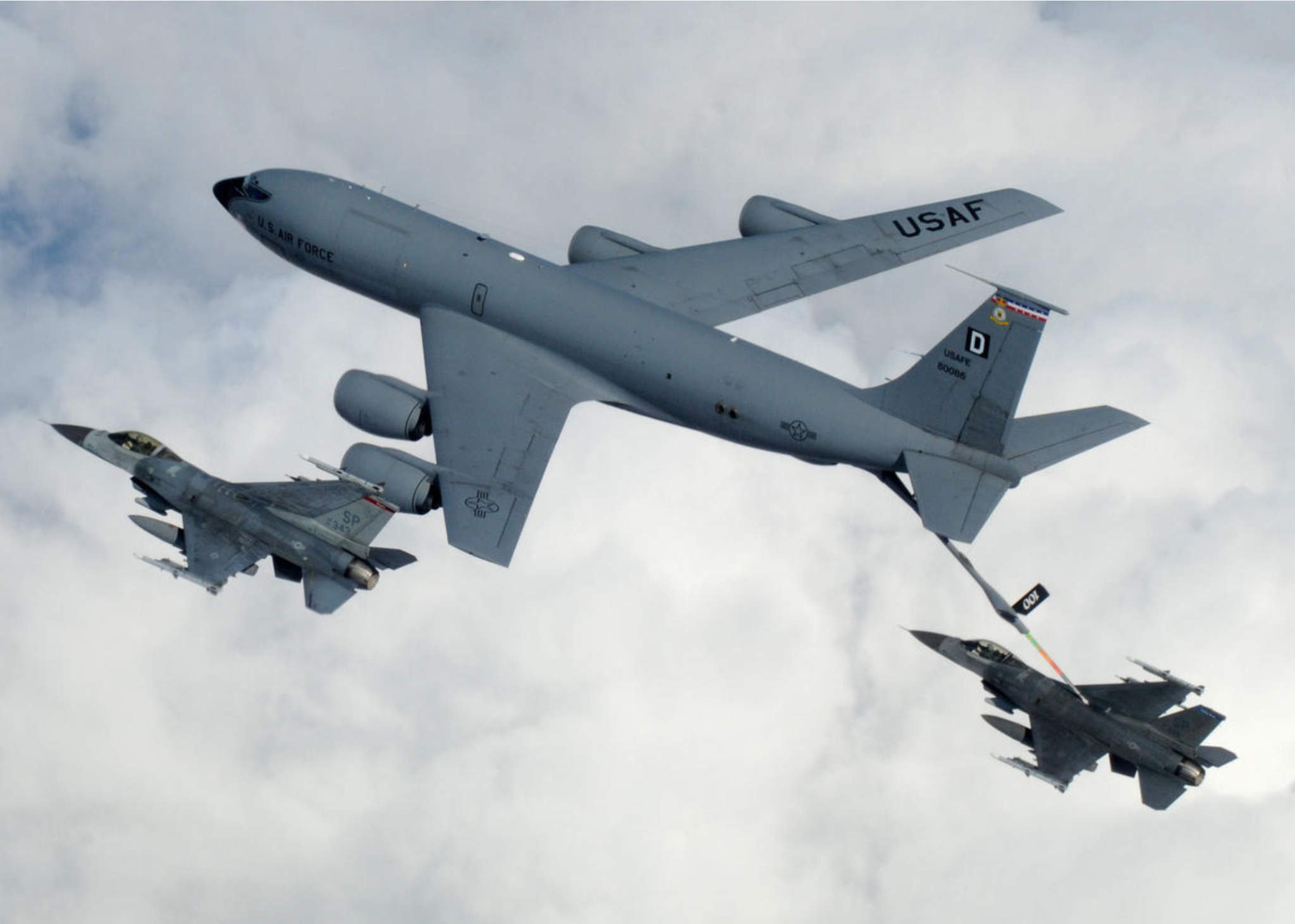
Listening on the 40m band I did hear a very interesting station, KN6IPA/Aeronautical-Mobile. Justin, KN6IPA is part of the crew on a USAF KC135 air-to-air refuelling tanker that flies out of RAF Lakenheath in the U.K. He was transmitting from the aircraft whilst in flight over Germany. His signal was between 5/9 and 5/9+20dB on my vertical antenna and had a massive pileup of people calling him from all over Europe.
I did try calling him with my punchy 10w of power but, couldn’t compete with the huge pileup of very loud, powerful stations all incessantly calling. It was really interesting to just sit back and listen to Justin’s information. He was using 300w into a wire antenna that runs from the fuselage to the vertical stabiliser. Of course being so high up he had a massive advantage and could be heard for hundreds of miles with ease, hence every one and their dog was calling him.
Photo of the KC135 tanker that KN6IPA was transmitting from courtesy of his QRZ.COM page
If you look closely at the photo above of the KC135 that Justin is a crew member on you can just make out the wire antenna on the vertical stabiliser.
I have to admit that I would love to spend a few hours on the radio aboard the KC135 whilst it was flying around, just imagine the DX you could work!
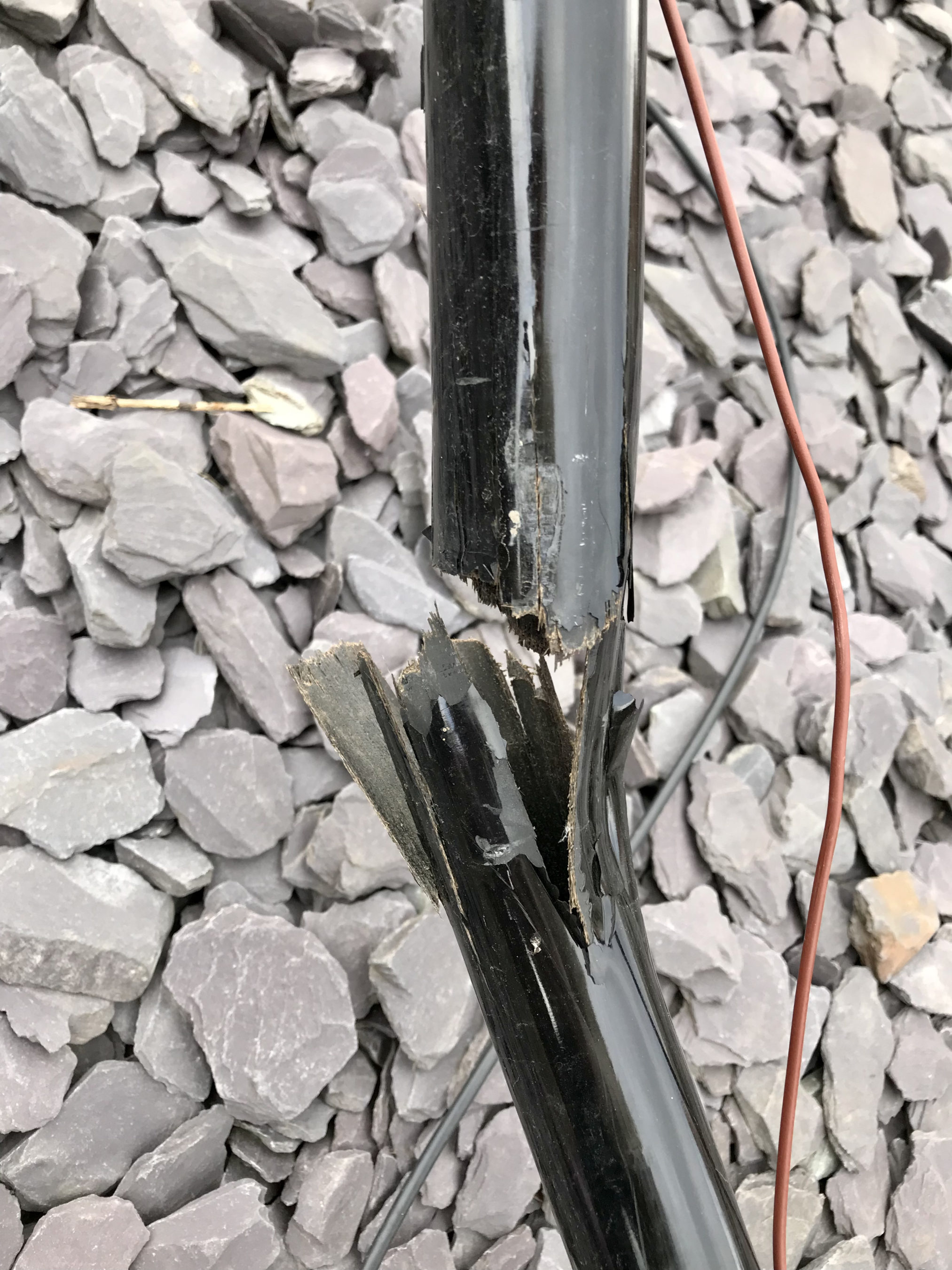
A few days ago we had a bit of a storm come through which brought down one of my extending fibreglass poles. Sadly I wasn’t home to be able to go out into the garden and take it down and hence I now have a badly broken pole.
It’s quite an old pole and has given me sterling service and so I can’t really complain. This has however, brought forward my decision to get something a little sturdier to hold up my wire creations.
Going online I finally ordered what I’ve really wanted for some time, a Spiderbeam Spiderpole 12m HD extending fibreglass pole. These poles really are much stronger than the cheap, thin walled fibreglass poles I’ve been using and so, should handle the wind somewhat better.
This will also allow me to get a longer wire into the air as it’s some 3m longer than the poles I’ve been using to date.
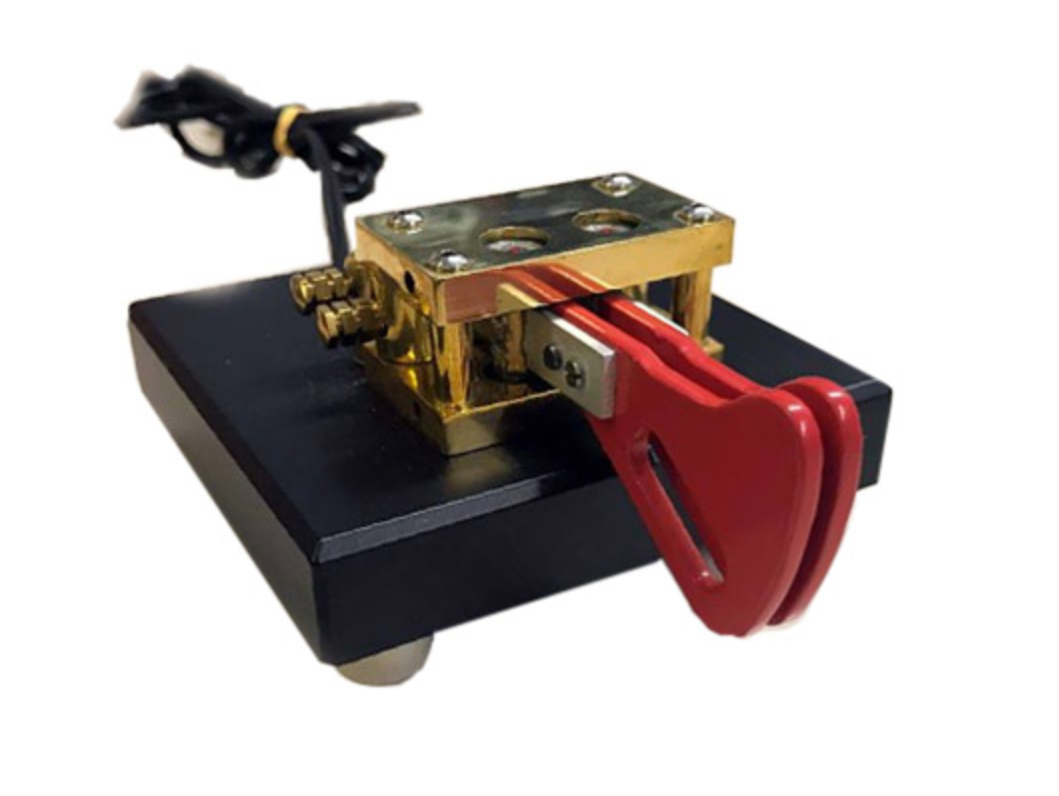
I also decided to order a new morse twin paddle key today too. I’ve been looking for some time but, couldn’t decide which key to purchase.
I finally decided to go with the Vine Twin Paddle RST-TP1 key. It’s quite a heavy lump so shouldn’t wander around the table during use. I’m looking forward to receiving it!
I recently acquired a CG3000 Automatic Remote antenna tuner from Ebay that was advertised as being new, still in the box unused. I’m always very wary about purchasing stuff from Ebay as the site is full of scams and cheap Chinese rubbish these days.
I decided it would be handy to have an auto remote ATU to enable me to band hop quickly and easily without having to go outside and tinker so, I thought I’d put in a silly offer and see what happens.
Putting in an incredibly low offer I didn’t expect to hear anything however, the following day the offer was accepted! At this point I thought well it’s either a scam or someone just wants rid of it for one reason or another.
4 days after paying for the unit it arrived and sure enough, it was new still in it’s box and original wrapping, bargain!
Initially I used the CG3000 to make an NVIS antenna for inter-G contacts on the low bands. It worked extremely well and I’ve kept the 30m long end fed wire in place so that I can chat with other UK stations throughout the summer months.
Wanting to experiment further with the CG3000 I thought I’d look into getting onto the WARC bands as summer is coming and the higher bands normally come alive during the warmer months. Having the CG3000 remote tuner in the garden already I decided to see if I could make a vertical that would work on the higher frequencies. I started to look into what length of wire I should use with the tuner to get the best results across the bands and finally decided to go with 8.3m.
8.3m might seem a strange length to go with but, there is method to my madness!
8.3m is a half wave on the 17m band, this should be great for DXing as it will have a very low angle of radiation, around 5 degrees.
On the 15m band it will be roughly a meter longer than a half wave but, modelling shows it will still be good for working the DX.
On the 12m band it will be just under a 3/4 wave length, it will have a higher angle of radiation than on 17m and 15m but, it should still work well.
On the 30m band it will be just over a 1/4 wave length, this will also be good for DXing and will give me another band to play with.
Finally, on the 40m band it will be a little shorter than a quarter wave but, should still work fairly well and give me the ability to switch between the 5 bands in seconds.
I’m not worried about using it on the 20m or 10m band as these two are covered by my 20m EFHW vertical antenna that has already proven to be a superb DX antenna.
In the back of the shed I had a new 8.5m long telescopic fibreglass pole that would be ideal for getting the wire into the air. The CG3000 needs a relatively good ground connection and radials to tune against, fortunately I’d already sorted the ground out when I set the tuner up for the 30m long end fed NVIS antenna.
CG3000 Automatic Remote ATU connected to ground and antenna wire
Powering it up it tuned on all the bands I wanted and as a bonus it tuned the 80m band too. I doubt it will be particularly good on 80m as 8.3m of wire is rather short for such a low frequency but, could be OK for local ground-wave chatter.
So it was time to get on the air and see how it performed.
First up was 17m, the band was active which was good to hear and I set about working a few stations.
Stations worked on the 17m band using the CG3000 ATU and vertical antenna
Working into Japan was a breeze on 17m, I couldn’t believe it when I got through to JA4FKX first call. I also got into Thailand HS6OKJ first call too. I worked a few European and Russian stations and then started hunting for stations further afield. It wasn’t long before I’d worked PY7ZC and PY2IQ in Brazil, YV4GLF in Venezuala and a bunch of East Coast USA stations. As the sun headed west I worked VE7SA and VA7QI on the West Coast of Canada.
Tuning up on the 15m band I found the it was pretty dead however, I did manage to work VE1JBC which proved the antenna worked on 21Mhz but, needed more testing when the conditions are better.
Tuning up onto 12m was the same story, completely dead apart from one station calling CQ, LU8EX in Argentina! I gave a call back and got an immediate reply. We exchanged signal reports and then he was gone. More testing is also needed on this band but, getting into Argentina more than proves it’s a DX worthy antenna for the 12m band.
Tuning onto the 30m band I found a hive of activity and so set about working stations to see how the CG3000 and antenna combo worked on the lower frequencies. To my surprise it was extremely effective.
Stations worked on the 30m band using the CG3000 ATU and vertical antenna
As you can see on the map above, the slightly long 1/4 wave length antenna worked very well on the 30m band and I’ve been able to get contacts in Japan, Russia, most of Europe and into the East Coast USA and Caribbean. 8.3m of vertical wire makes an extremely good 30m band antenna!
I didn’t have a lot of time to check out the 40m band however, I did manage to work a few stations before I had to disappear. The CG3000 ATU tuned the 8.3m of wire up beautifully and I was surprised how many stations I could hear during the daylight hours.
Stations worked on the 40m band using the CG3000 ATU and vertical antenna
I worked a few stations on 40m before closing down and heading off to do other, more important things. Considering it was still daylight I was impressed to get UI4P at just under 2000 miles. I clearly need to spend more time on the 40m band late into the night to see how well the antenna performs but, it looks promising!
So overall, the CG3000 remote auto tuner and 8.3m of wire give me exactly what I wanted, 17, 15m and 12m with the added bonus of 30m and 40m. DXing over the summer months will be a lot of fun for sure!
UPDATE: It works incredibly well on the 60m band too! I’ve just had to manage my first ever FT8 pileup on 60m including contacts into Canada, USA and Puerto Rico.
More soon …
Multi-band vertical tuned with CG3000 Remote Auto Tuner
To recap, the NVIS antenna is a 30m long end-fed wire that is between 3 and 4m above the ground over it’s entire length. This is the longest wire I could get into my tiny U.K. garden and so I wanted to see what was really possible with such a low short wire on the low bands. My goal was to get good Inter-G signals so that I could chat with other U.K. and close European stations during the summer months. The tuning is done automatically by the CG3000 remote ATU I picked up very cheaply on Ebay.
Having very anti-antenna neighbours I have to tread carefully not to upset them as I have already rattled some cages having the 20m EFHW Vertical on an extending fibre glass pole at the end of the garden overlooking the farmers field.
The CG3000 remote ATU matches the 30m wire nicely on the 160m band with an SWR of less than 1.2:1 across the entire band with multiple retunes. It’s certainly very convenient to have such a setup.
Setting the power output on the radio to 25w which is the maximum I use for FT4/FT8 on the Yaesu FTDX10 I started WSJT-X and waited to see what I could hear. With the background noise swinging between S7-9 most of the time I was surprised at how many stations were being decoded. Some of the stations were barely visible on the waterfall but, I got consistent reliable decodes.
Stations heard during a 1 hour period on 160m NVIS Antenna Experiment
As you can see on the map above I was hearing stations from all over Europe and well into Russia. There certainly isn’t the proliferation of stations on the 160m band that there are on the 40m band but, there were enough for me to get some good results.
It was nice to reliably copy some U.K. stations on 160m FT8 even though I didn’t hear a single SSB station on the band.
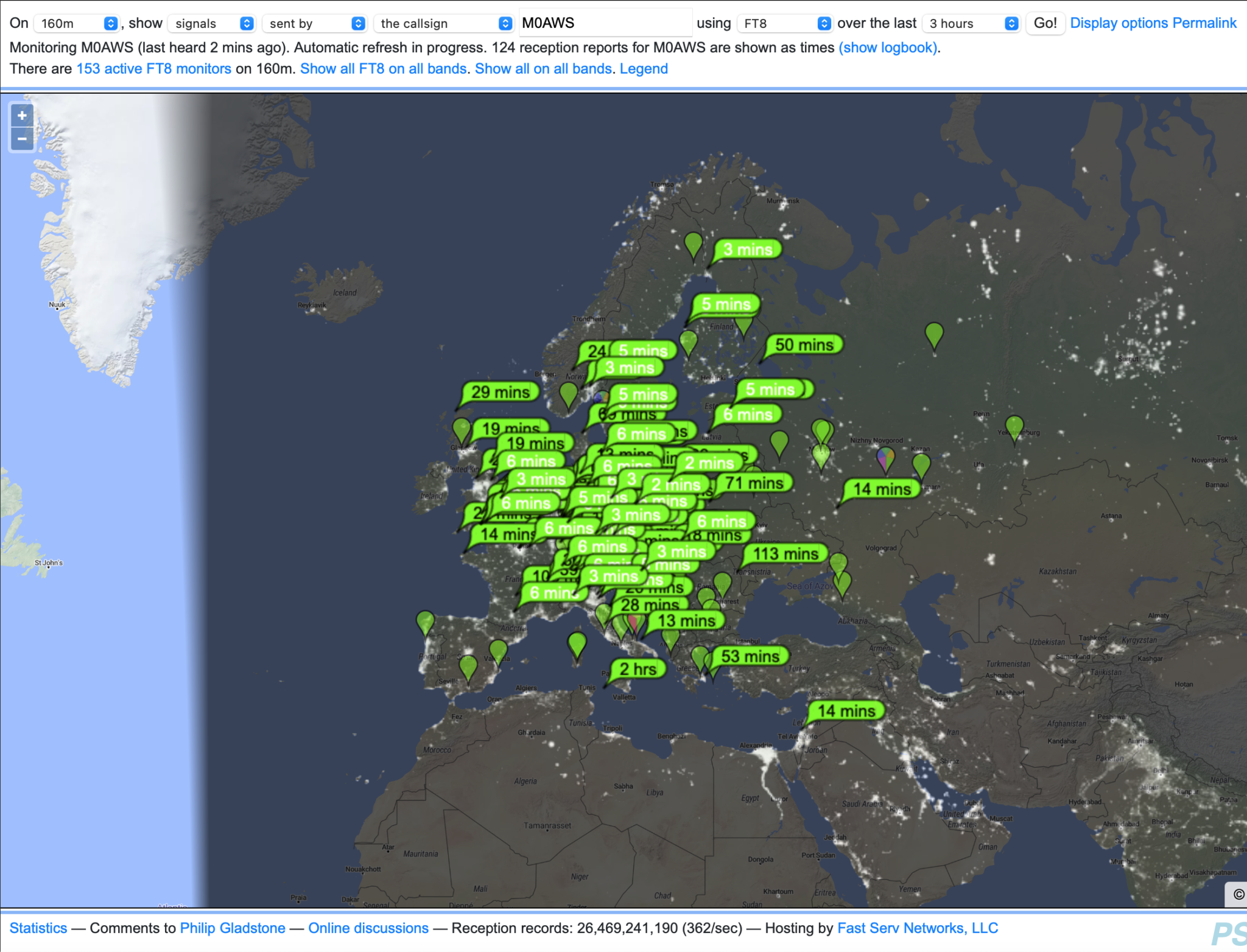
Map showing stations that heard M0AWS on 160m during the NVIS Antenna Experiment
Over a period of about 3.5 hours I was heard by a good number of European stations but, wasn’t able to work all that I heard as I was struggling to compete with the much more powerful stations. Limiting my transmit power to 25w to protect the PA on the radio does tend to limit my success at getting through to stations at times but, I am a firm believer in being able to hear better than I can shout, especially on the low bands.
Map showing all stations worked during the 160m NVIS Antenna Experiment
Over the test period I didn’t work a huge number of stations but, I did manage to work stations over a large area of Europe with the best distance being 1004 Miles into Finland, much further than I ever thought would be possible with such a simple setup.
I’m sure that when the band is in better shape with lower noise levels and better propagation the antenna will post probably perform better but, it’s certainly proved it can do the short hop NVIS comms that I was looking for.
I have designed a new NVIS antenna for the garden which manages to incorporate considerably more wire into the same space that is resonant on the 80m band. With the CG3000 remote ATU it should tune up well on 40m-160m and give much better results. This design does require a 10m fibre glass expending pole which I need to purchase before I can erect it in the garden. I’ll get all the information for the design onto the Antenna section of the website soon.
So to summarise, a 30m end-fed wire at between 3 and 4m above the ground will give good NVIS results on 40m-160m with a very low visual impact. For those like me that have a small garden, a simple antenna like this is much better than no antenna at all.
Following on from my 40m band NVIS antenna experiment I ran the same series of tests on the 80m band to see how well the NVIS antenna works.
Being only 30m long the antenna isn’t very well suited to the low bands but, with the tiny garden we have here in the U.K. and the anti-antenna neighbours it’s the best I can do.
I started off looking for SSB contacts only to find no one on the band. I eventually found G8MNY calling CQ from Croydon south of London. He was a huge 5/9+20db with me so I was hopeful that he’d hear me.
Tuning up the antenna on 3.710Mhz and setting the O/P to 40w I gave him a call and got an immediate response. We ended up chatting for around 30mins with ease, the band wasn’t too noisy and Jon was running 400w so he was a solid signal with me. My 40w got me a 5/8 report which I was very happy with.
Once we cleared I tuned around the band and even called CQ a few times, but there was nothing to be heard.
I went and had something to eat and then returned to the shack before the greyline, the band was a little more lively and so I switched over to FT8 mode and started working stations.
Stations initially heard on FT8 whilst still in daylight
I was really quite surprised how many stations I could hear and make contact with even though I was still in daylight. The effect of the greyline really is quite pronounced.
Stations that heard me on FT8 whilst still in daylight
I was being heard by a good number of continental stations even though I was still in daylight. Signal strengths were good and I was soon working stations one after another with ease.
As the night drew closer and the U.K. moved into darkness stations further east started appearing on the WSJT-X window and I was surprised how many I was able to work considering how low and short the antenna is for this band.
German stations were always the strongest throughout the test which is to be expected with an NVIS antenna as they are just across the north sea as the crow flies.
Map showing all stations heard on FT8 during 80m NVIS antenna experiment
By the end of the evening I’d heard a good number of stations with the most distant being north of the Kazakhstan/Mongolian border as shown on the map above.
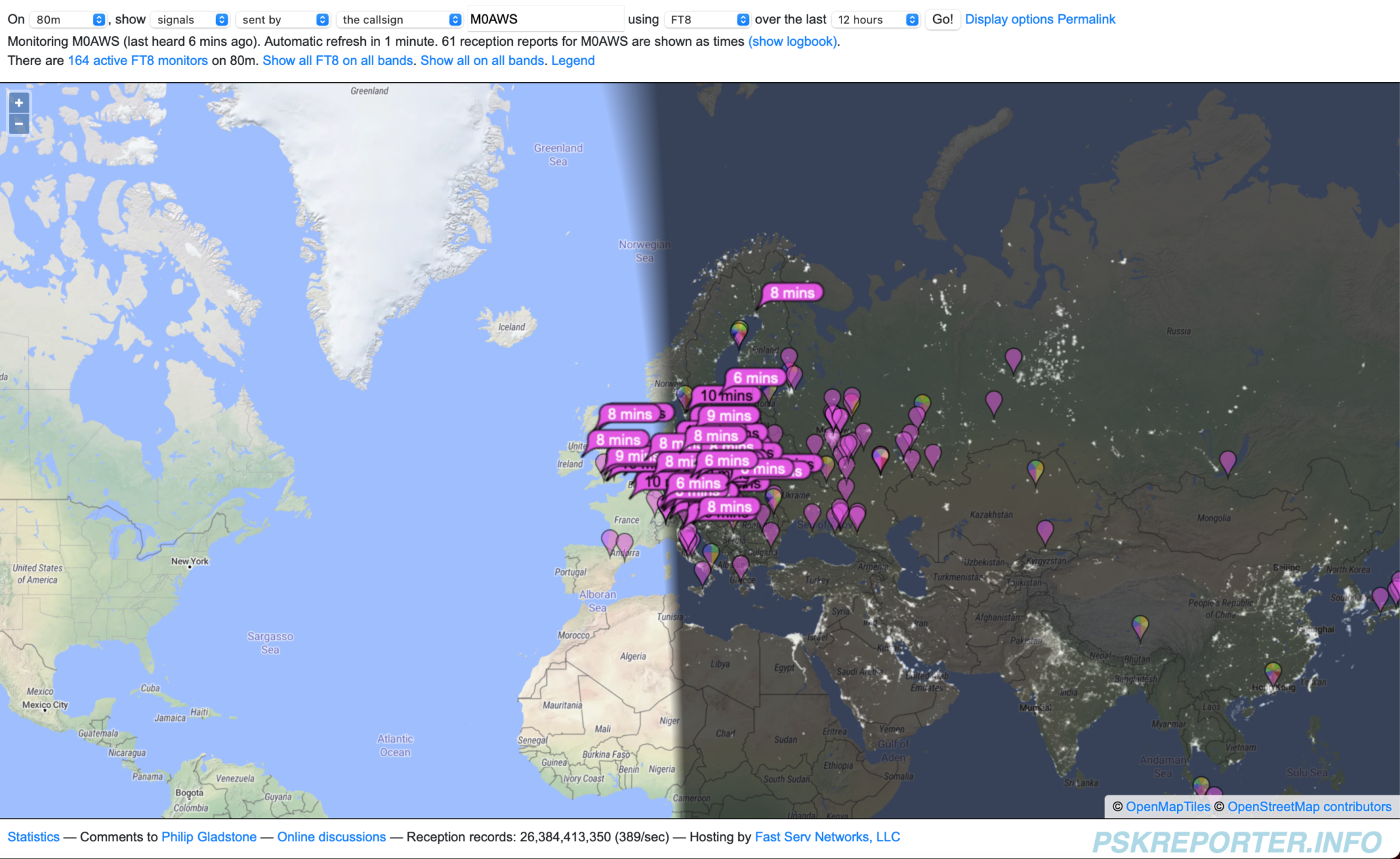
All stations that heard M0AWS on FT8 throughout the NVIS antenna experiment
I was pleasantly surprised at how many stations were hearing me throughout the test, getting as far south as the islands off the coast of north Africa and well into Russia was amazing for a horizontal antenna that is only 4m-5m above the ground.
Map of all stations worked during the 80m NVIS antenna experiment
The number of contacts was nowhere near as prolific as during the 40m experiment mainly due to the fact that the band wasn’t as busy however, the contact pattern was very similar to that on 40m with the most distant station being R2EA/P just south east of Moscow at 1544 miles.
European coverage was very good but, sadly I didn’t hear many U.K. stations and so I’m not sure how well my Inter-G coverage will be. Perhaps another test during the day when conditions are better will shed some more light on this.
Overall I’m very happy with the antenna performance on the 80m band, it’ll certainly be ideal for European chat during the summer months and hopefully inter-G will be good too.
Next will be a test on 160m, this could be interesting!
Since setting up the new station at my U.K. QTH I’ve not had any Inter-G contacts. This has mainly been due to the fact that the antennas I’ve currently got in place are all designed for chasing DX and so have far too low a radiation angle to be able to talk to other U.K. stations.
One of the things I do like about radio is the local chatter on the low bands. In the summer months working Inter-G on the low bands is most enjoyable so, I decided to put up a simple Near Vertical Incident Skywave (NVIS) antenna ready for the summer.
Unlike my French QTH, here in Suffolk we only have a tiny garden and so it’s a challenge to get any length of wire up that is anywhere near long enough for the low bands.
A quick measuring of the garden I worked out I could get 30m of wire approximately 3-4m off the ground at best. I’m very aware of my anti-antenna neighbours and so it needs to be as stealthy as possible.
I decided to use some 1.5mm wire that I had in the workshop and utilise the high washing line poles that are already in place to get the wire along the max length of the garden.
With the wire in place and connected to the CG3000 auto remote tuner that I got off of Ebay for a song, ground post and radials connected I found that the antenna tunes up fine on all 3 low bands, perfect!
Tuning up on the 40m band I had an SWR 1:1 anywhere on the band. I could hear a number of strong U.K. stations and a few Dutch and German stations too. Since I’m on the East Coast of the U.K. The Netherlands and Germany aren’t that far away as the crow flies.
Setting the radio onto 40w SSB (First time on SSB in a very long time!) I put out a call. First station to come back was G8VVY, Robin in Malmesbury Wiltshire. Signals weren’t particularly strong and I gave him a 4/4 report and got a 5/5 in return.
Next station was PA3GLK, Dave in The Netherlands. Again signal reports were 5/5 and 5/6 but, perfectly readable.
Next up was G0SXC, Kevin in Lancashire. Signal reports were 5/9 both ways this time, very strong and fully quietening, the high angle radiation was doing its thing!
Last call was ON3PAT, Pat in Belgium. Very strong signals both ways, 5/9++ at a distance of 153 miles. NVIS propagation is working very well. I turned the output down to just 25w and Pat still gave me a 5/9 report.
Later in the day I decided to run some FT8 QSOs on 40m to see how far I could get reliably with no more than 25w. I was hoping that I may just be able to get 1000 miles as an absolute maximum but, be able to work stations at 100 Miles or less with ease.
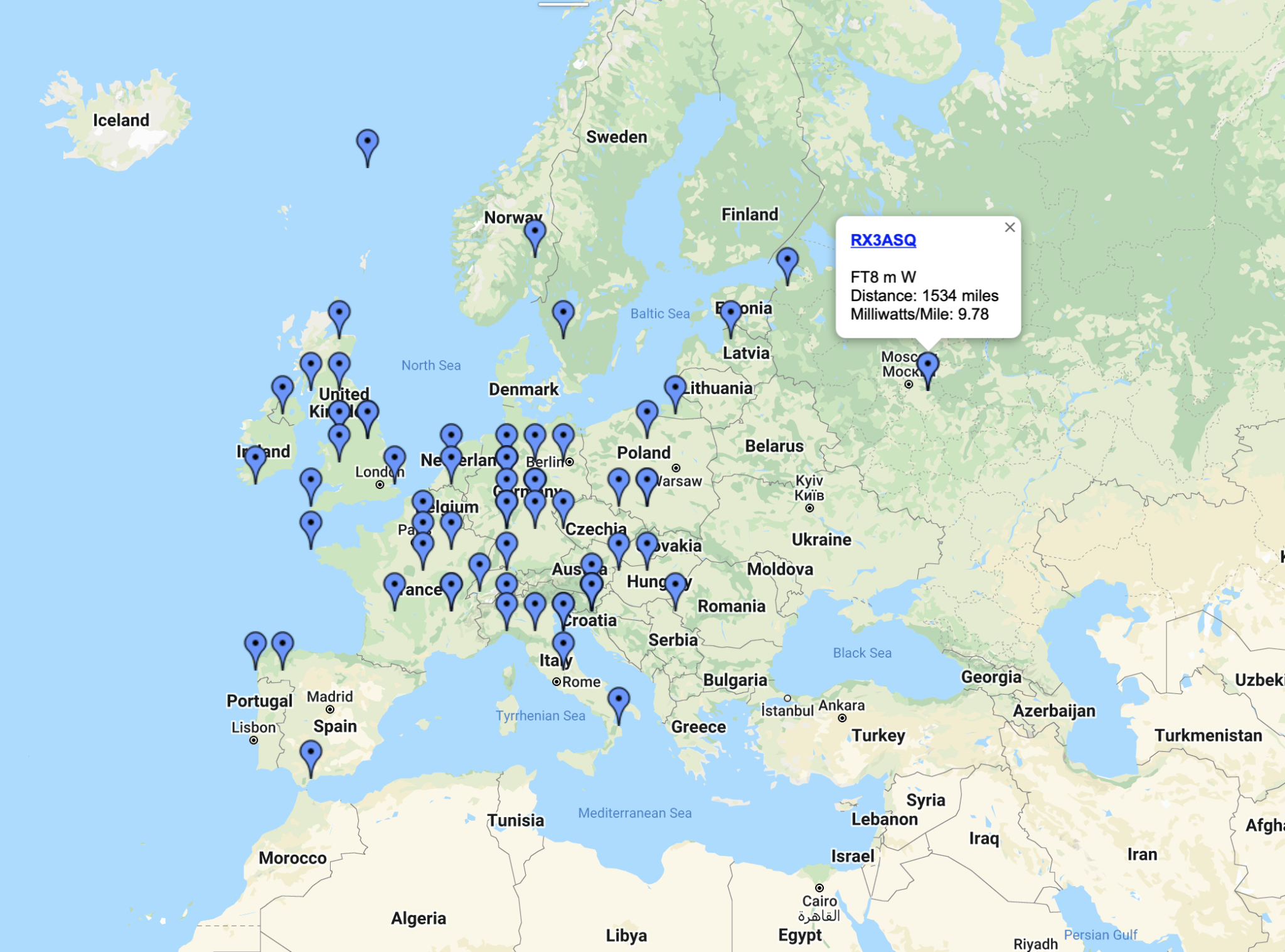
Map showing NVIS FT8 contacts on the 40m band
As you can see on the map above, 1534 miles was the best achieved, RX3ASQ just east of Moscow. The thing that pleased me most was the number of U.K. stations I could hear with the closest being just 43 miles away. Most European stations were easily worked even with reduced levels of power (10w) and so I’m hoping that this simple end fed NVIS antenna will become my goto antenna for local chatter on the 40m band.
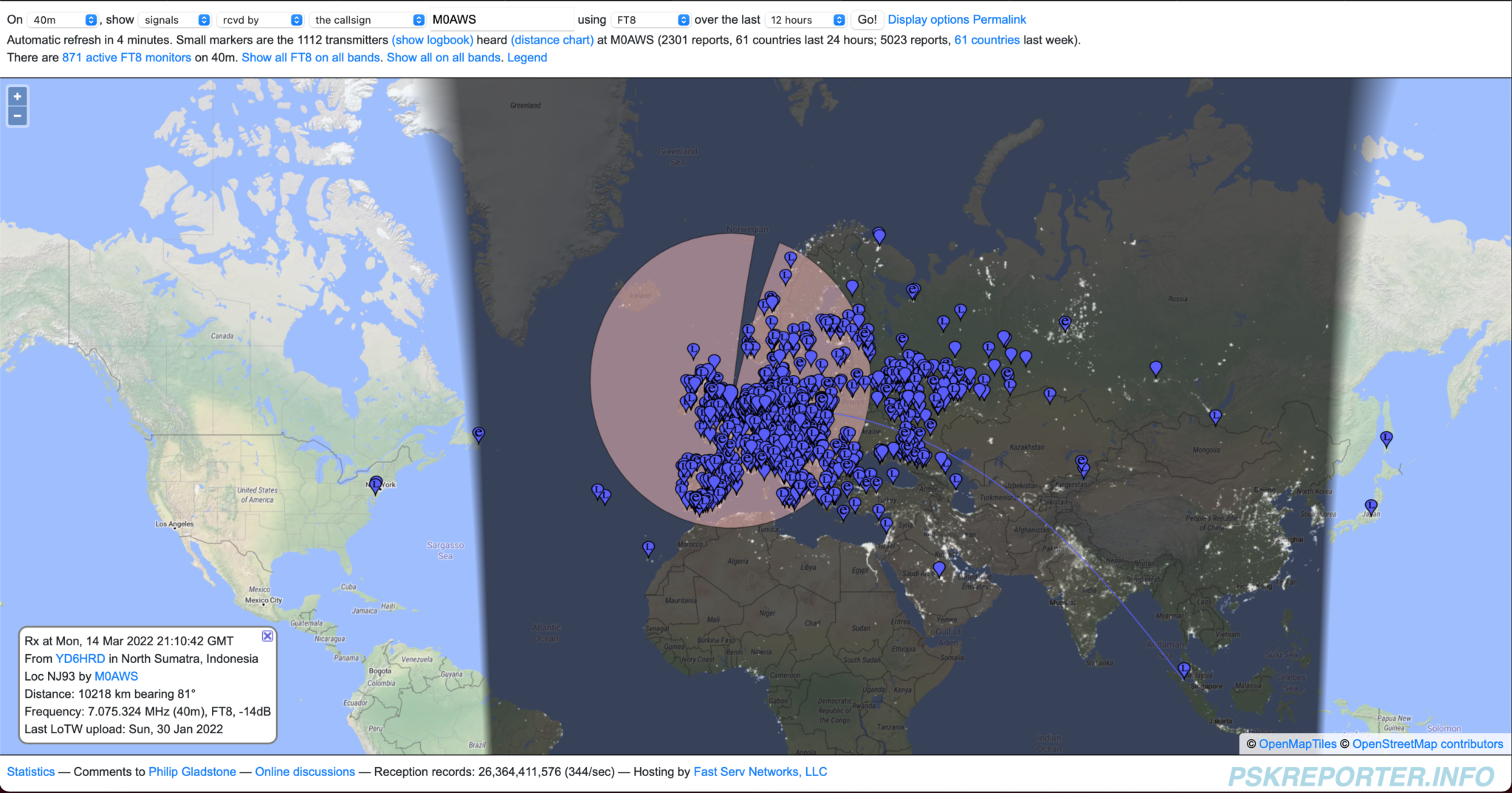
What was very interesting was what I could hear on the antenna, I didn’t expect to hear any DX stations at all however, I was surprised to see stations from Mongolia, Japan and the USA popping up in the WSJT-X window.
Obviously I couldn’t get back to them as my angle of radiation was far too high to get a signal out over those distances but, it just goes to show what can be a heard on a very low long wire.
Map showing stations heard on 40m using NVIS antenna
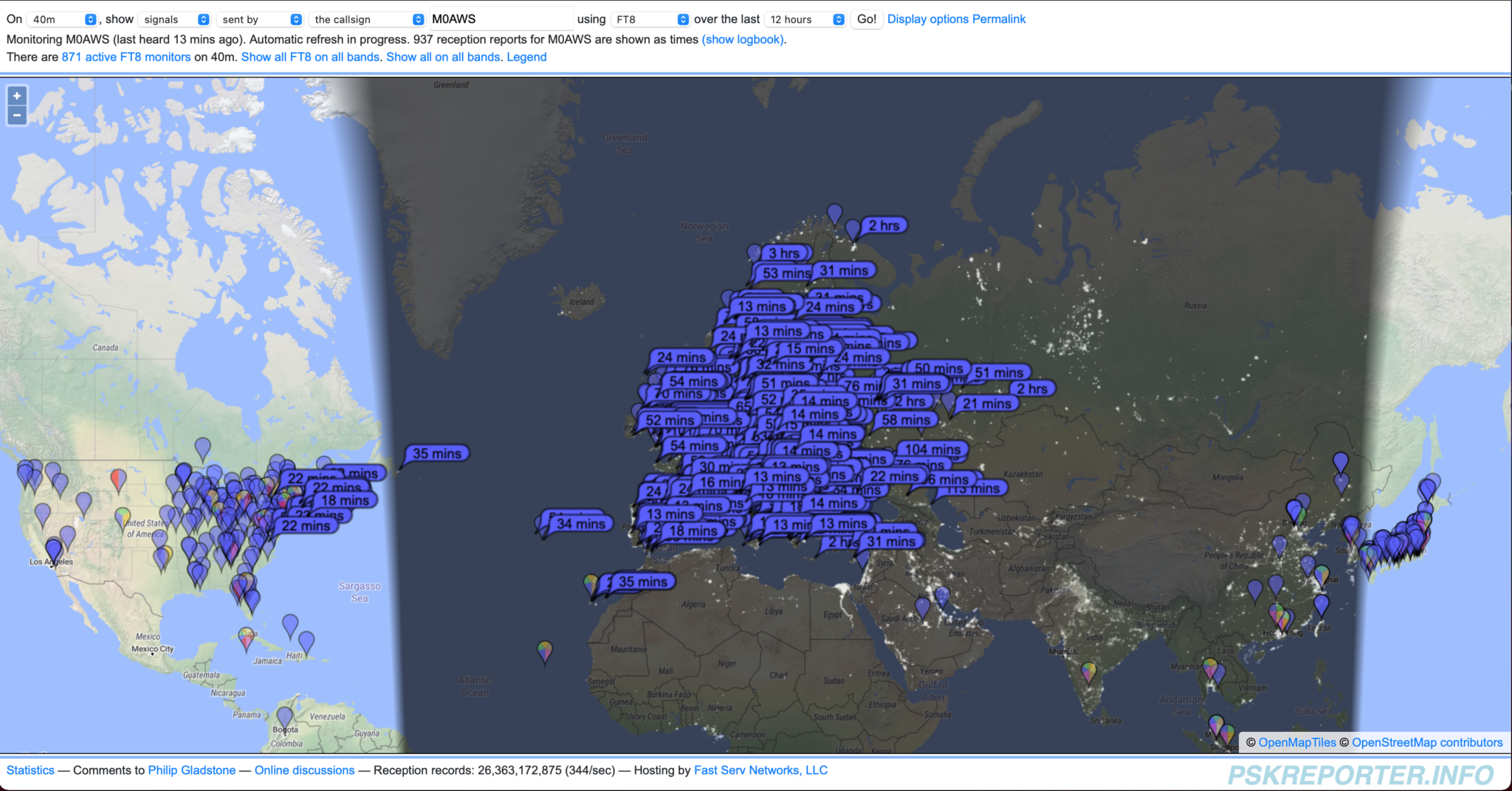
By the end of the evening to my surprise I had been heard in the USA, I was amazed to see where I’d managed to get into with such a low antenna. The main cluster of stations were in the U.K. and Europe of course which is exactly what I wanted from this antenna.
Stations that heard M0AWS on 40m FT8 using NVIS antenna
So the next test will be on the 80m band, I’m hoping to get similar results on SSB with inter-G stations being easy to work. I doubt I will be able to get anywhere near the 1500 miles I achieved on the 40m band but, I’ll be more than happy with U.K. and EU stations.
More soon …
We use cookies to ensure that we give you the best experience on our website. If you continue to use this site we will assume that you are happy with it.